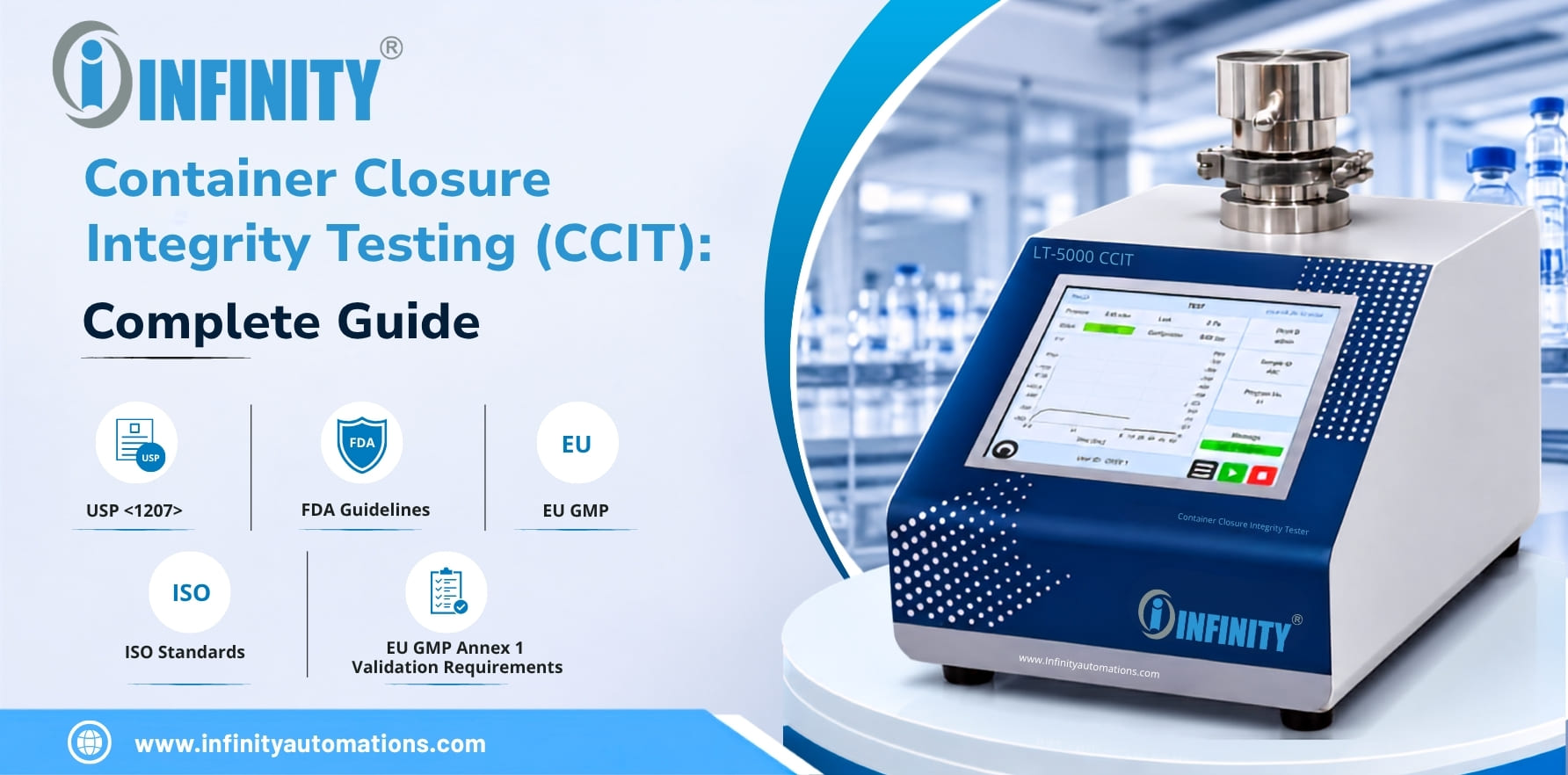
Container Closure Integrity Testing (CCIT): Complete Guide
In the pharmaceutical and healthcare industries, maintaining the sterility and integrity of packaged products is essential for ensuring patient safety and product effectiveness. Sterile medicines, injectable drugs, vaccines, biologics, and medical devices must remain protected from contamination throughout their shelf life. Even microscopic leaks in a container closure system can allow microorganisms, moisture, oxygen, or other contaminants to enter the package, potentially compromising product quality and leading to costly recalls or regulatory non-compliance.
This is why leak testing has become a critical part of pharmaceutical quality assurance. Traditional visual inspection methods are often unable to detect extremely small leaks, making advanced testing technologies essential for modern manufacturing. Container Closure Integrity Testing (CCIT) provides a reliable and scientifically validated method for verifying that pharmaceutical packaging maintains a secure and sterile seal throughout storage, transportation, and distribution.
A Container Closure Integrity Test evaluates whether the packaging system—including vials, ampoules, prefilled syringes, IV bags, bottles, and other sterile containers—can effectively prevent contamination while preserving product stability. Various deterministic testing methods, such as Vacuum Decay Testing, Pressure Decay Testing, and High Voltage Leak Detection, enable manufacturers to detect even microscopic leaks with high accuracy while meeting stringent regulatory standards like USP <1207>, FDA guidelines, and EU GMP Annex 1.
As pharmaceutical manufacturing continues to adopt automation and Industry 4.0 technologies, modern CCIT Machines are increasingly integrated into production lines to deliver faster testing, real-time data recording, and improved traceability. These advanced systems help manufacturers maintain consistent quality while ensuring compliance with global regulatory requirements.
Infinity Automation Systems Private Limited, established in 2006 in Pune, Maharashtra, specializes in advanced Leak Testing Systems and customized industrial automation solutions. Our expertise in precision leak detection, automated inspection systems, and quality assurance technologies enables manufacturers to achieve reliable Container Closure Integrity Testing while improving production efficiency, regulatory compliance, and overall product quality.
What is Container Closure Integrity Testing (CCIT)?
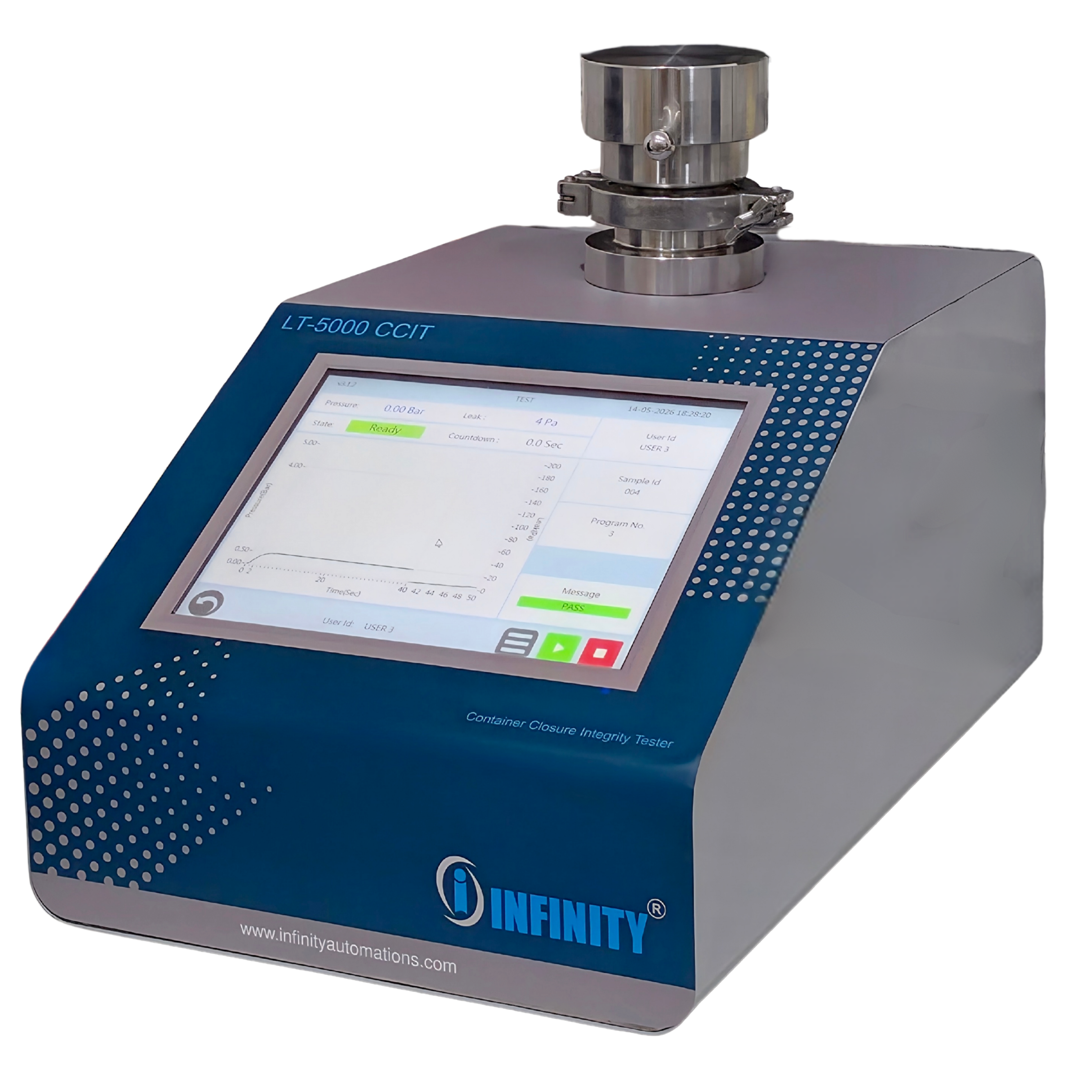
Container Closure Integrity Testing (CCIT) is a scientifically validated testing process used to verify whether a pharmaceutical container and its closure system can maintain a complete, leak-free seal throughout the product's shelf life. The primary objective of a Container Closure Integrity Test is to ensure that sterile pharmaceutical products remain protected from contamination caused by microorganisms, moisture, gases, or other external environmental factors.
CCIT plays a crucial role in pharmaceutical manufacturing by confirming that packaging systems such as vials, ampoules, prefilled syringes, IV bags, bottles, cartridges, and medical containers maintain their integrity during storage, transportation, and distribution. Modern CCIT Machines utilize advanced deterministic technologies to detect even microscopic leaks that may not be visible during routine visual inspection.
Why is CCIT Performed?
The pharmaceutical industry follows strict quality standards because even the smallest packaging defect can compromise product sterility and patient safety. Container Closure Integrity Testing is performed to verify that every sealed container provides a reliable barrier against contamination throughout its lifecycle.
Manufacturers perform CCIT to:
- Ensure product sterility and patient safety
- Detect microscopic leaks before products reach the market
- Prevent contamination from microorganisms, moisture, and oxygen
- Maintain product stability and shelf life
- Meet regulatory requirements such as USP <1207>, FDA guidelines, and EU GMP Annex 1
- Reduce product recalls and manufacturing risks
- Improve quality assurance and process validation
By incorporating CCIT into pharmaceutical quality control, manufacturers can deliver safe and reliable products while maintaining compliance with international regulatory standards.
Difference Between Leak Testing and Container Closure Integrity Testing (CCIT)
Although the terms Leak Testing and Container Closure Integrity Testing (CCIT) are often used interchangeably, they serve different purposes and are applied in different industries.
Leak Testing
- Used across multiple industries such as automotive, packaging, industrial manufacturing, and consumer products
- Detects air, gas, or pressure leaks in industrial components and assemblies
- Focuses on product functionality and performance
- Common methods include pressure decay, vacuum decay, and flow testing
- Suitable for industrial quality control
Container Closure Integrity Testing (CCIT)
- Primarily used in pharmaceutical, biotechnology, and medical device manufacturing
- Verifies the integrity of sterile pharmaceutical packaging and container closure systems
- Focuses on maintaining sterility, product quality, and patient safety
- Uses validated deterministic methods such as Vacuum Decay, Pressure Decay, and High Voltage Leak Detection
- Required for pharmaceutical regulatory compliance and packaging validation
While general Leak Testing ensures that industrial components perform as intended, Container Closure Integrity Testing specifically ensures that sterile pharmaceutical packaging remains contamination-free throughout its intended shelf life.
Importance of CCIT in Pharmaceutical Manufacturing
In modern pharmaceutical manufacturing, maintaining container closure integrity is just as important as producing the medicine itself. Even microscopic leaks can allow contaminants to enter the package, potentially affecting product quality, reducing shelf life, and putting patient safety at risk.
Container Closure Integrity Testing provides manufacturers with confidence that every packaged product maintains a secure sterile barrier until it reaches the end user. It also supports automated quality inspection, regulatory compliance, and process validation while reducing manufacturing defects and costly product recalls.
As pharmaceutical manufacturing increasingly adopts automation, digital quality monitoring, and Industry 4.0 practices, advanced CCIT Machines have become an essential part of quality assurance systems. These technologies enable fast, accurate, and non-destructive testing, helping manufacturers improve efficiency while consistently meeting global pharmaceutical standards.
For manufacturers seeking reliable and automated testing solutions, Infinity Automation Systems Private Limited provides advanced Leak Testing Systems and customized automation solutions designed to support precise inspection, quality assurance, and efficient manufacturing processes across regulated industries.
Why is Container Closure Integrity Testing (CCIT) Important?
In the pharmaceutical and biotechnology industries, maintaining the integrity of sterile packaging is just as important as manufacturing the product itself. Even a microscopic leak can allow microorganisms, moisture, oxygen, or other contaminants to enter the container, compromising product quality and patient safety. Container Closure Integrity Testing (CCIT) is a critical quality assurance process that verifies whether a container closure system can maintain a complete and sterile seal throughout the product's lifecycle.
1. Ensures Product Sterility
Sterility is one of the most critical requirements for injectable drugs, vaccines, biologics, and other pharmaceutical products. CCIT verifies that the container closure system forms a complete and secure seal, preventing microorganisms, moisture, and gases from entering the package. This helps preserve the sterility and effectiveness of the product until it reaches the patient.
2. Protects Patient Safety
Patient safety depends on the quality and integrity of pharmaceutical packaging. Even a small leak can compromise sterile medicines, increasing the risk of contamination and reducing product effectiveness. Container Closure Integrity Testing identifies packaging defects before products are released, helping manufacturers deliver safe and reliable healthcare products.
3. Extends Product Shelf Life
A properly sealed container protects pharmaceutical products from environmental factors such as oxygen, humidity, and moisture. By maintaining package integrity, CCIT helps preserve product stability, potency, and quality throughout storage and transportation, ultimately extending the product's shelf life.
4. Supports Regulatory Compliance
Regulatory authorities require pharmaceutical manufacturers to demonstrate that their packaging systems maintain container closure integrity. CCIT helps companies comply with international standards such as USP <1207>, FDA Guidelines, EU GMP Annex 1, and other pharmaceutical quality regulations. Implementing validated CCIT methods also simplifies audits and regulatory inspections.
5. Prevents Product Contamination
One of the primary objectives of Container Closure Integrity Testing is to prevent contamination throughout the product lifecycle. By detecting leaks in vials, ampoules, prefilled syringes, IV bags, and other sterile containers, CCIT minimizes the risk of microbial ingress and ensures that pharmaceutical products remain safe during storage, transportation, and distribution.
6. Detects Microscopic Leaks with High Accuracy
Modern CCIT Machines use advanced deterministic testing methods such as Vacuum Decay Testing, Pressure Decay Testing, and High Voltage Leak Detection to identify microscopic leaks that are impossible to detect through visual inspection alone. These highly sensitive technologies improve inspection accuracy, reduce product rejection, and support consistent quality assurance across pharmaceutical manufacturing processes.
Regulatory Requirements for Container Closure Integrity Testing (CCIT)
Regulatory authorities worldwide require pharmaceutical manufacturers to verify that sterile packaging maintains its integrity throughout the product's shelf life. Container Closure Integrity Testing (CCIT) helps ensure compliance with these standards while protecting product quality and patient safety.
- USP <1207> – One of the most widely recognized standards for Container Closure Integrity Testing. It recommends scientifically validated deterministic testing methods over traditional probabilistic methods whenever possible.
- FDA Guidelines – The U.S. Food and Drug Administration recommends validated CCIT methods to confirm the integrity of pharmaceutical packaging.
- EU GMP – The European Union Good Manufacturing Practice guidelines require pharmaceutical manufacturers to implement appropriate testing procedures to verify the integrity of sterile packaging.
- ISO Standards – Provide guidance for quality management systems, validation processes, and testing procedures used in pharmaceutical manufacturing.
- EU GMP Annex 1 – Focuses on the manufacture of sterile medicinal products and emphasizes the importance of maintaining container closure integrity.
- Validation Requirements – Every Container Closure Integrity Test should be properly validated to demonstrate its accuracy, sensitivity, repeatability, and reliability.
Working Principle of Container Closure Integrity Testing (CCIT)
Container Closure Integrity Testing (CCIT) is a non-destructive testing process used to verify that a pharmaceutical container and its closure system are completely sealed and free from leaks. Modern CCIT Machines use advanced technologies such as Vacuum Decay Testing, Pressure Decay Testing, and High Voltage Leak Detection to identify even microscopic leaks with high accuracy.
1. Test Setup
The sealed pharmaceutical container, such as a vial, ampoule, prefilled syringe, IV bag, or bottle, is placed inside the CCIT Machine. The machine is configured according to the product type, container size, and required testing parameters to ensure accurate and repeatable results.
2. Pressure or Vacuum Application
Depending on the selected testing method, the machine applies a controlled vacuum or positive pressure around or inside the container. This creates a pressure difference that helps identify any defects or microscopic leaks in the container closure system.
3. Leak Detection
Advanced sensors continuously monitor changes in pressure, vacuum, or electrical conductivity during the test. If the container has even a tiny leak, the system detects the variation and accurately identifies the defective package. Modern CCIT Machines can detect leaks that are too small to be identified through visual inspection.
4. Pass/Fail Evaluation
After completing the test cycle, the machine automatically compares the measured values with predefined acceptance limits. Containers that meet the required integrity standards receive a Pass result, while defective containers are marked as Fail and can be automatically rejected from the production line.
5. Data Recording and Traceability
Modern CCIT Systems automatically record test results, including pressure values, leak rates, pass/fail status, date, time, and batch information. This data provides complete traceability, supports regulatory compliance, and simplifies quality audits and validation processes.
Types of Container Closure Integrity Testing (CCIT)
Various Container Closure Integrity Testing (CCIT) methods are used to verify the integrity of sterile pharmaceutical packaging. These methods are broadly classified into Deterministic Methods, which provide quantitative and highly reliable results, and Probabilistic Methods, which rely on visual observation or biological indicators and are generally used for validation or destructive testing.
1. Vacuum Decay Testing (Deterministic)
One of the most widely used CCIT methods. The sealed container is placed inside a test chamber where a controlled vacuum is applied. Any pressure change indicates a leak.
Key Benefits: Non-destructive, detects microscopic leaks, high accuracy and repeatability, suitable for automated production lines.
Non-destructive High sensitivity Automated2. Pressure Decay Testing (Deterministic)
The container is pressurized, and the system monitors pressure changes over a specified period. A pressure drop indicates a leak in the container closure system.
Key Benefits: Accurate and reliable results, fast inspection process, easy automation integration, ideal for quality control applications.
Fast Reliable Easy integration3. High Voltage Leak Detection (HVLD) (Deterministic)
Uses a controlled electrical current to detect defects in non-porous pharmaceutical containers filled with conductive liquids. Any discontinuity changes the electrical flow.
Key Benefits: Non-destructive, high sensitivity for liquid-filled containers, suitable for vials, ampoules, and prefilled syringes.
High sensitivity Liquid-filled Regulatory compliant4. Helium Leak Testing (Deterministic)
Uses helium gas as a tracer to detect extremely small leaks. The package is filled with helium, and specialized sensors measure any escaping gas.
Key Benefits: Extremely high leak detection sensitivity, suitable for critical applications, reliable quantitative results.
Ultra-precise Validation & R&D High-value products5. Dye Ingress Testing (Probabilistic)
A traditional method where the container is immersed in a colored dye solution under vacuum or pressure. If the dye enters the container, it indicates a leak.
Key Benefits: Simple testing procedure, cost-effective for validation studies, suitable for visual leak detection.
Simple Cost-effective Validation studies6. Microbial Ingress Testing (Probabilistic)
Evaluates whether microorganisms can penetrate the container closure system under controlled conditions. Mainly used during package validation.
Key Benefits: Verifies sterility assurance, supports package validation, used for regulatory studies.
Sterility assurance Regulatory studies ValidationApplications of Container Closure Integrity Testing (CCIT)
Container Closure Integrity Testing (CCIT) is widely used in the pharmaceutical, biotechnology, and medical device industries to ensure that sterile packaging remains leak-free and contamination-free throughout its lifecycle.
- Pharmaceutical Vials – CCIT is extensively used to test glass and plastic pharmaceutical vials containing injectable drugs, vaccines, and biologics.
- Syringes – Verifies the integrity of syringe barrels, plungers, and sealing components before product release.
- Ampoules – Helps detect microscopic cracks or seal defects in pharmaceutical ampoules.
- IV Bags – Confirms the integrity of the bag, ports, and seals for safe delivery of intravenous medications.
- Prefilled Syringes – Verifies that each syringe remains leak-proof throughout manufacturing, storage, and transportation.
- Pharmaceutical Bottles – Ensures bottles and their closure systems provide an effective barrier against moisture, oxygen, and microbial contamination.
- Medical Devices – Verifies the integrity of packaging for devices such as catheters, diagnostic kits, and surgical products.
- Biotech Packaging – Ensures sensitive biotechnology products remain protected from contamination while complying with regulatory standards.
Benefits of Container Closure Integrity Testing (CCIT)
Container Closure Integrity Testing (CCIT) offers significant advantages for pharmaceutical manufacturers by ensuring sterile packaging remains secure throughout the product lifecycle.
- Detects Microscopic Leaks – Modern CCIT Machines can identify extremely small leaks that are impossible to detect through visual inspection.
- Non-Destructive Testing – Most deterministic methods allow products to be tested without damaging the packaging, reducing waste and improving efficiency.
- Enhances Product Safety – Verifies that every container is properly sealed, protecting pharmaceutical products from contamination.
- Ensures Regulatory Compliance – Helps manufacturers comply with USP <1207>, FDA Guidelines, and EU GMP Annex 1.
- Improves Product Quality – Reliable leak detection ensures only properly sealed products move forward in production.
- Reduces Product Recalls – Detecting packaging defects during manufacturing minimizes costly product recalls.
- Supports Automation – Modern CCIT Machines can be integrated into automated production lines for high-speed testing and real-time quality control.
- Provides Documentation & Traceability – Advanced systems automatically record test results, batch information, and timestamps for complete quality documentation.
Choosing the Right CCIT Machine
Selecting the right Container Closure Integrity Testing (CCIT) Machine is essential for ensuring reliable leak detection, regulatory compliance, and efficient pharmaceutical production.
- Product Type – Ensure the CCIT Machine is compatible with the container type, material, and closure system.
- Leak Rate Sensitivity – Choose a machine that offers the sensitivity needed to detect even microscopic leaks.
- Automation Level – For high-volume manufacturing, select a machine that integrates seamlessly with automated production lines.
- Throughput Requirements – Evaluate your production capacity and choose a system capable of testing large volumes efficiently.
- Regulatory Requirements – Ensure the solution supports compliance with USP <1207>, FDA Guidelines, and EU GMP Annex 1.
- Validation and Technical Support – Choose a manufacturer that provides validation support, calibration, documentation, and after-sales service.
Why Choose Infinity Automation Systems?
Selecting the right partner for Container Closure Integrity Testing (CCIT) is essential for ensuring pharmaceutical product quality, regulatory compliance, and manufacturing efficiency. Infinity Automation Systems Private Limited, established in 2006 in Pune, Maharashtra, has earned a reputation for delivering advanced Leak Testing Systems and customized industrial automation solutions for a wide range of industries.
We specialize in designing and manufacturing CCIT Machines and precision Leak Testing Systems that help manufacturers detect leaks accurately, maintain sterile packaging integrity, and meet stringent pharmaceutical quality standards. Our solutions are engineered to deliver reliable performance, high accuracy, and seamless integration into modern production environments.
In addition to Container Closure Integrity Testing, our expertise includes Industrial Automation, Vision Inspection Systems, and Turnkey Assembly Automation. Every solution is customized to meet specific production requirements, helping manufacturers improve productivity, reduce manual intervention, and maintain consistent product quality.
At Infinity Automation Systems, we believe our commitment doesn't end with machine delivery. Our experienced team provides comprehensive after-sales support, including installation, operator training, preventive maintenance, technical assistance, and ongoing service to ensure long-term machine performance and customer satisfaction.
Partner with Infinity Automation Systems
Whether you require a CCIT Machine, Leak Testing System, or a complete industrial automation solution, our experts are ready to help you find the right solution for your manufacturing needs.
Address: S No. 80/2A, Mumbai Bangalore Bypass Highway, Near JSPM Engineering College, Ashok Nagar, Tathawade, Pune – 411033, Maharashtra, India
Phone: +91 93256 40283 / +91 93256 40285 / +91 93256 40287
Email: sales@infinityautomations.com
Website: https://www.infinityautomations.com
Looking for a Reliable Container Closure Integrity Testing (CCIT) Machine?
Contact Infinity Automation Systems today to discuss your application requirements. Our engineering team will help you implement the right testing and automation solution to improve product quality, ensure regulatory compliance, and enhance manufacturing efficiency.
Get in Touch Today →Conclusion
Container Closure Integrity Testing (CCIT) has become an essential part of modern pharmaceutical manufacturing, ensuring product quality, sterile packaging, and patient safety. By detecting even microscopic leaks, CCIT helps manufacturers maintain product integrity, comply with global regulatory standards, and reduce the risk of contamination.
As the pharmaceutical industry continues to embrace automation and Industry 4.0, advanced CCIT Machines are enabling faster, more accurate, and data-driven quality inspection. Investing in reliable Container Closure Integrity Testing solutions not only ensures regulatory compliance but also prepares manufacturers for the future of smart, efficient, and high-quality pharmaceutical production.
Frequently Asked Questions (FAQs)
Container Closure Integrity Testing (CCIT) is a testing method used to verify that pharmaceutical containers and their closure systems are completely sealed and free from leaks. It helps maintain product sterility, quality, and patient safety throughout the product's shelf life.
CCIT is essential because it detects microscopic leaks that could allow contaminants such as microorganisms, moisture, or gases to enter sterile pharmaceutical packaging. It helps ensure product quality, regulatory compliance, and patient safety.
USP <1207> is a pharmaceutical standard that provides guidance on Container Closure Integrity Testing. It recommends the use of validated deterministic testing methods to verify the integrity of sterile packaging and ensure reliable leak detection.
The best CCIT method depends on the product type and application. Vacuum Decay Testing, Pressure Decay Testing, and High Voltage Leak Detection (HVLD) are widely used deterministic methods that provide accurate, repeatable, and non-destructive testing for pharmaceutical packaging.
Yes. Most modern CCIT Machines use non-destructive testing methods, allowing pharmaceutical products to be inspected without damaging the packaging. This helps reduce product waste while maintaining high inspection accuracy.
Container Closure Integrity Testing is primarily used in the pharmaceutical, biotechnology, medical device, healthcare, and life sciences industries. It is commonly applied to vials, ampoules, prefilled syringes, IV bags, bottles, and other sterile packaging systems.
A CCIT Machine is specialized equipment designed to perform Container Closure Integrity Testing. It uses advanced technologies such as Vacuum Decay, Pressure Decay, or High Voltage Leak Detection to identify leaks and verify the integrity of sterile pharmaceutical packaging.
Selecting the right CCIT Machine depends on factors such as the container type, leak detection sensitivity, production volume, automation requirements, regulatory compliance, and validation needs. Choosing a reliable and customized solution helps ensure accurate testing, improved quality assurance, and efficient pharmaceutical manufacturing.