How Servo Technology Enhances Hot Plate Welder Performance and Weld Quality
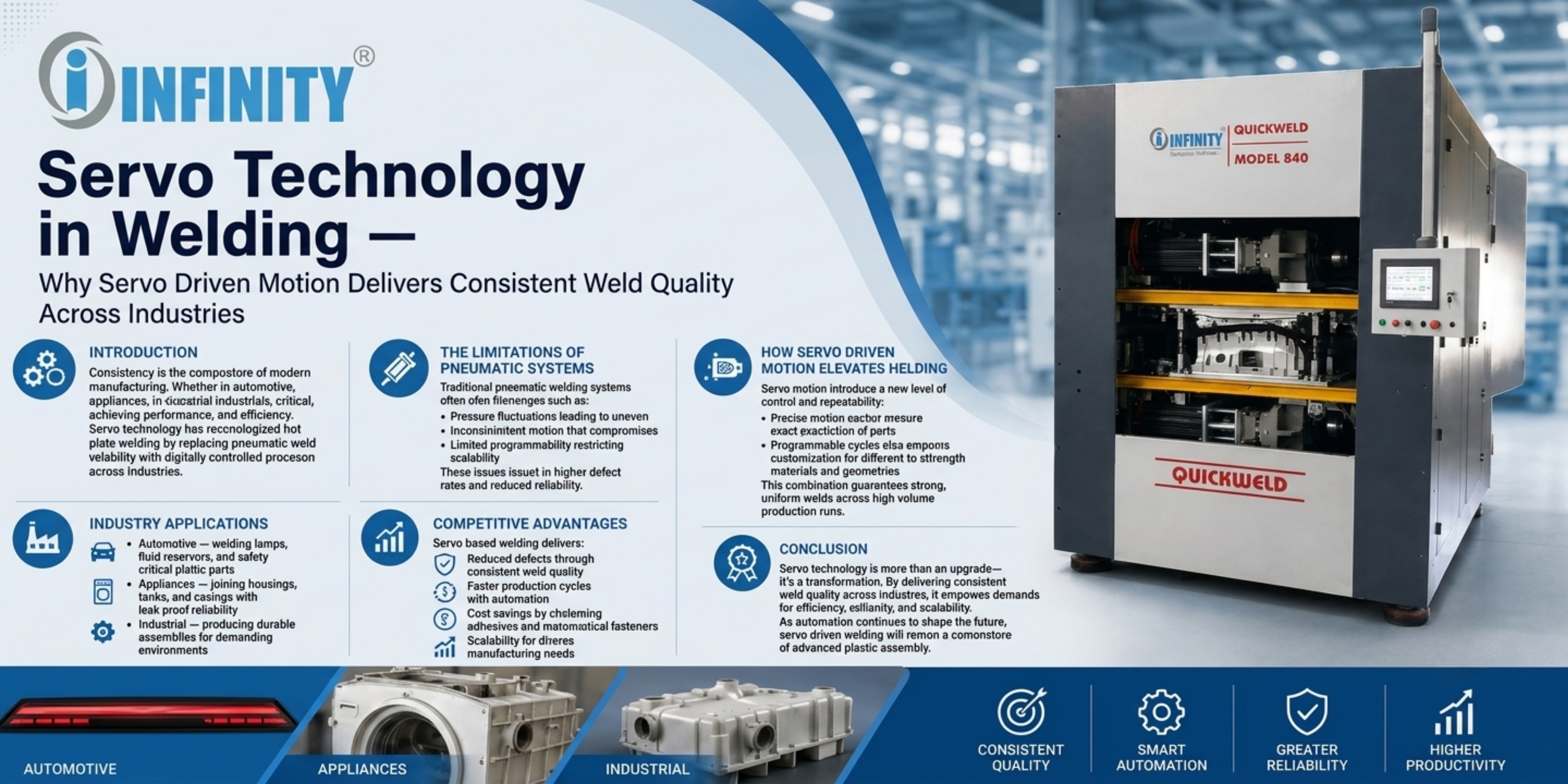
Precision, repeatability, and product quality are essential success elements in today's cutthroat manufacturing industry. To meet these demanding manufacturing standards, Infinity Automation Systems provides advanced plastic welding solutions engineered for accuracy, consistency, and long-term reliability. Industries such as automotive, appliance manufacturing, medical devices, and industrial equipment rely heavily on plastic welding technologies to create durable and leak-proof assemblies. Among the various joining methods available, the Hot Plate Welder remains one of the most dependable joining techniques for thermoplastic components.
However, conventional pneumatic welding methods frequently fail to provide the uniformity and control required for contemporary manufacturing as production demands rise. Here is where the welding process has been revolutionized by servo technology. Servo-driven hot plate welders offer better weld quality, increased productivity, and enhanced process dependability by combining sophisticated motion control, real-time monitoring, and programmable welding parameters.
This article shows why manufacturers are implementing servo-driven systems, how servo technology improves Hot Plate Welder performance, and how it helps ensure consistent weld quality across industries.
What is a Hot Plate Welder?
A Hot Plate Welder is a specialized plastic welding machine used to join thermoplastic components by heating the mating surfaces against a temperature- controlled hot plate. Once the surfaces reach the required temperature, the hot plate is removed and the components are pressed together under controlled pressure to create a strong and permanent bond.
Hot plate welding is widely used because it:
- Produces strong and durable welds
- Creates leak-proof joints
- Eliminates the need for adhesives and fasteners
- Supports large and complex plastic parts
- Provides excellent repeatability for mass production
Industries commonly using Hot Plate Welders include automotive, industrial manufacturing, consumer products, medical devices, and household appliances.
The Limitations of Traditional Pneumatic Welding Systems
Many conventional welding systems rely on pneumatic cylinders for motion control. While pneumatic technology has served manufacturers for years, it presents several challenges in modern production environments.
- Pressure Variations – Compressed air systems can experience pressure fluctuations, resulting in inconsistent welding force and variable weld quality.
- Limited Motion Accuracy – Pneumatic cylinders provide limited control over movement speed, acceleration, and positioning accuracy.
- Reduced Process Traceability – Traditional systems typically lack detailed process monitoring, making quality validation difficult.
- Higher Rejection Rates – Inconsistent movement and force application can increase weld defects, product failures, and manufacturing waste.
As industries demand tighter quality standards and greater automation, manufacturers are increasingly turning to servo-driven solutions.
What is Servo Technology in Hot Plate Welding?
Servo technology utilizes advanced servo motors and controllers to precisely regulate machine movements throughout the welding cycle.
Unlike pneumatic systems, servo-driven Hot Plate Welders provide complete control over:
- Position
- Speed
- Acceleration
- Deceleration
- Welding force
- Travel distance
- Cycle timing
This level of precision ensures every welding cycle is executed exactly as programmed.
How Servo Technology Enhances Hot Plate Welder Performance
1. Precise Position Control
Servo motors deliver highly accurate positioning throughout the welding process.
- Consistent component alignment
- Improved dimensional accuracy
- Reduced weld variation
- Better product quality
Precise positioning is especially important for complex plastic assemblies and high-tolerance applications.
2. Consistent Welding Force
A major advantage of servo technology is the ability to apply controlled and repeatable welding pressure.
- Uniform material fusion
- Stronger weld joints
- Reduced risk of weak welds
- Improved leak-proof performance
Consistent force application is essential for safety-critical components used in automotive and industrial applications.
3. Programmable Welding Profiles
Servo-controlled systems allow manufacturers to create customized welding recipes for different products and materials. Parameters can be adjusted based on:
- Material type
- Part geometry
- Weld strength requirements
- Production speed
This flexibility supports multiple product variants on a single machine platform.
4. Real-Time Process Monitoring
Modern servo-driven Hot Plate Welders continuously collect production data during each welding cycle. Monitored parameters include:
- Position
- Force
- Speed
- Temperature
- Cycle time
- Weld displacement
This data supports quality assurance, process validation, and Industry 4.0 initiatives.
5. Improved Repeatability
Servo systems ensure every welding cycle follows identical movement profiles.
- Consistent weld quality
- Reduced production variability
- Lower rejection rates
- Greater manufacturing reliability
Repeatability is one of the primary reasons manufacturers are upgrading to servo-based welding systems.
Applications of Servo Driven Hot Plate Welders
Automotive Industry
Servo-controlled Hot Plate Welders are widely used for:
- Tail lamp assemblies
- Washer fluid reservoirs
- Coolant tanks
- Air intake systems
- Battery housings
These applications require strong, leak-proof, and highly reliable welds.
Appliance Manufacturing
Manufacturers use hot plate welding for:
- Washing machine components
- Water tanks
- Dishwasher assemblies
- Appliance housings
Servo technology improves both productivity and product quality.
Industrial Products
Industrial manufacturers rely on hot plate welding for:
- Fluid handling systems
- Plastic enclosures
- Industrial reservoirs
- Process equipment components
Servo-driven systems ensure durability in demanding operating environments.
Key Benefits of Servo Driven Hot Plate Welders
- Superior Weld Quality – Precise motion control produces stronger and more consistent weld joints.
- Reduced Defects – Controlled process parameters minimize welding errors and product rejections.
- Faster Production – Optimized motion profiles reduce cycle times and increase throughput.
- Lower Manufacturing Costs – Reduced scrap rates and elimination of secondary joining methods lower overall production costs.
- Enhanced Traceability – Real-time data collection supports quality documentation and compliance requirements.
- Industry 4.0 Readiness – Servo systems integrate seamlessly with smart manufacturing and automation environments.
Why Manufacturers Are Investing in Servo Controlled Hot Plate Welders
As global competition increases, manufacturers need technologies that deliver:
- Higher product quality
- Better process control
- Faster production cycles
- Lower operating costs
- Greater scalability
Servo-driven Hot Plate Welders address these challenges while supporting future-ready manufacturing strategies.
Companies investing in advanced welding automation gain a significant competitive advantage through improved efficiency, consistency, and reliability.
Conclusion
Servo technology has transformed the performance capabilities of modern Hot Plate Welders. By delivering precise motion control, programmable welding profiles, real-time monitoring, and exceptional repeatability, servo-driven systems help manufacturers achieve superior weld quality while increasing productivity and reducing operational costs.
As manufacturing continues to evolve toward automation and Industry 4.0, servo-controlled Hot Plate Welders will remain a critical solution for producing reliable, high-quality thermoplastic assemblies across automotive, industrial, appliance, and medical applications.
Manufacturers seeking consistent weld performance, enhanced process control, and long-term operational efficiency should consider servo-driven hot plate welding as a strategic investment for the future.
Looking for advanced Servo Driven Hot Plate Welder solutions?
Contact Infinity Automation Systems→