Get the Right Plastic Welding Machine for Your Application
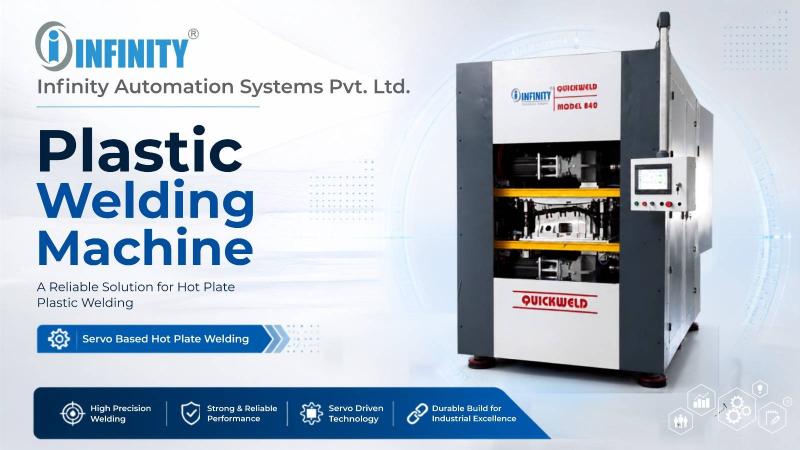
Product quality, production speed, and process consistency are more crucial than ever in today's cutthroat industrial climate. Automotive, medical, electrical, appliance, packaging, and industrial equipment manufacture are among the industries that need joining solutions that support high-volume production while producing durable, leak-proof joins.
A Plastic Welding Machine and a Hot Plate Welder have become essential technologies for manufacturers looking to join thermoplastic components without using adhesives, screws, rivets, or chemical solvents. These advanced welding systems produce high-strength molecular bonds, ensuring durability, precision, and long-term performance even in demanding industrial applications.
Unlike traditional assembly methods, a Plastic Welding Machine uses controlled heat, pressure, and programmable motion to fuse plastic parts into a single, integrated component. A Hot Plate Welder, in particular, is ideal for welding large, irregular, and complex thermoplastic components that require uniform heating and reliable sealing.
At Infinity Automation Systems Pvt. Ltd., we manufacture customized Plastic Welding Machines and Hot Plate Welders engineered to meet the specific requirements of modern production lines. Our servo-driven automation technology provides accurate positioning, intelligent temperature control, repeatable welding cycles, and customized tooling to deliver exceptional welding quality across various industrial applications.
Whether you manufacture automotive fuel tanks, battery housings, medical devices, HVAC components, fluid reservoirs, or appliance parts, investing in the right Plastic Welding Machine and Hot Plate Welder improves production efficiency, reduces rejection rates, and ensures consistent product quality.
What is a Plastic Welding Machine?
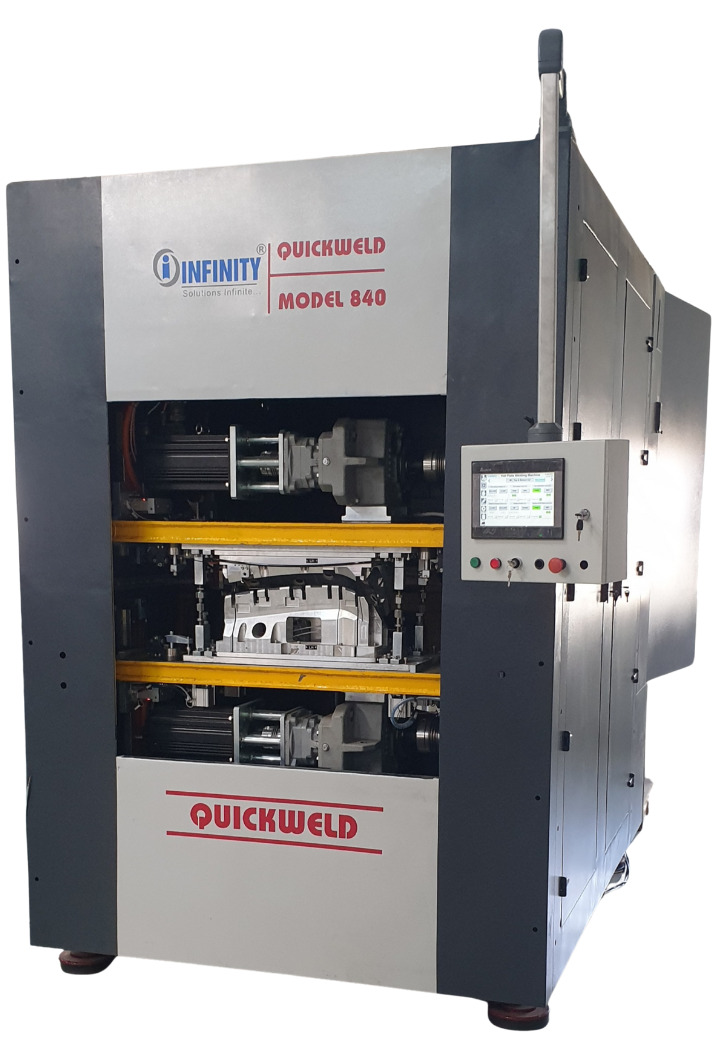
A Plastic Welding Machine is an industrial system designed to permanently join two or more thermoplastic components by applying controlled heat, pressure, and precise mechanical movement. Instead of relying on adhesives or mechanical fasteners, the machine softens the plastic surfaces until they reach the required welding temperature and then presses them together to create a permanent molecular bond.
Because the plastic materials fuse together at the molecular level, the resulting joint is extremely strong, durable, and resistant to leakage. This makes a Plastic Welding Machine the preferred choice for industries where reliability and product performance are critical.
Modern Plastic Welding Machines are available in several technologies, including:
- Hot Plate Welding
- Ultrasonic Welding
- Vibration Welding
- Spin Welding
- Infrared Welding
- Laser Plastic Welding
Among these methods, the Hot Plate Welder is one of the most versatile solutions for joining medium and large thermoplastic components with complex geometries.
What is a Hot Plate Welder?
A Hot Plate Welder is a specialized type of Plastic Welding Machine that joins thermoplastic components by heating their mating surfaces with a precisely controlled heated platen (hot plate). Once the surfaces reach the required melting temperature, the heated plate retracts automatically, and the softened plastic parts are pressed together under controlled pressure. After cooling, the components form a strong, permanent, and leak-resistant weld.
A Hot Plate Welder is particularly suitable for applications requiring:
- Large welding surfaces
- High-strength structural joints
- Leak-proof sealing
- Complex part geometries
- Consistent production quality
- Automated manufacturing
Compared with conventional joining methods, a Hot Plate Welder delivers better joint strength, improved repeatability, and lower production costs for high-volume manufacturing.
Why Industries Choose Plastic Welding Machines and Hot Plate Welders
Manufacturers are increasingly replacing conventional fastening methods with advanced welding technology because it offers measurable improvements in productivity, quality, and operational efficiency.
Strong and Permanent Joints
A Plastic Welding Machine creates a molecular bond between thermoplastic components rather than simply attaching them mechanically. This results in joints capable of withstanding vibration, pressure, and long-term use.
Leak-Proof Sealing
A Hot Plate Welder is widely used for products that must prevent liquid or gas leakage, including coolant tanks, fuel system components, battery housings, and fluid reservoirs.
High Production Efficiency
Automation enables manufacturers to complete welding cycles quickly with minimal operator intervention, increasing production output while maintaining consistent quality.
Excellent Repeatability
Servo-controlled Plastic Welding Machines ensure identical weld quality across thousands of production cycles, reducing scrap rates and improving manufacturing consistency.
Lower Assembly Costs
Since no adhesives, screws, rivets, or solvents are required, manufacturers benefit from lower material costs, simplified assembly processes, and reduced maintenance.
Automation and Industry 4.0 Compatibility
Modern Hot Plate Welders can integrate with robotic loading systems, PLC controls, barcode traceability, MES platforms, and smart factory environments, making them ideal for Industry 4.0 manufacturing.
Working Principle of a Plastic Welding Machine
A Plastic Welding Machine operates using a controlled thermal fusion process. The machine heats the contact surfaces of thermoplastic components to a predetermined temperature. Once the material reaches the correct molten state, controlled pressure is applied to fuse the parts together. After a programmed cooling period, the joint solidifies into a single, durable structure.
To ensure consistent welding quality, the process is precisely controlled through programmable parameters such as:
- Heating temperature
- Heating time
- Melting pressure
- Welding pressure
- Cooling duration
- Servo travel distance
- Position accuracy
- Cycle timing
This level of control enables manufacturers to produce high-quality welded components with minimal variation, even in continuous production environments.
How a Hot Plate Welder Works: Step-by-Step Process
A servo-based Hot Plate Welder follows a carefully controlled sequence to achieve accurate, repeatable, and high-strength welds.
Step 1: Component Loading
The upper and lower plastic components are positioned in precision-engineered fixtures. Customized jigs ensure accurate alignment and prevent movement during the welding process.
Step 2: Servo Positioning
High-precision servo motors move the tooling and welding assemblies into the programmed position. Servo technology provides superior positioning accuracy compared with pneumatic systems and allows complete control over movement speed, travel distance, and repeatability.
Step 3: Controlled Heating
A heated platen moves between the plastic components. The mating surfaces are brought into contact with the hot plate under controlled pressure until they reach the required melting temperature. Multiple independently controlled heating zones ensure uniform heat distribution across the entire weld surface.
Step 4: Hot Plate Retraction
After the plastic surfaces have softened sufficiently, the hot plate retracts automatically. The transition is fast and accurate, minimizing heat loss before the welding stage begins.
Step 5: Welding
The softened plastic components are pressed together under a precisely controlled welding force. The molten surfaces fuse together at the molecular level, creating a permanent and durable bond.
Step 6: Cooling
The welded assembly remains clamped until the joint cools and solidifies. Controlled cooling prevents deformation, internal stress, and dimensional variation, ensuring high-quality finished components.
Advanced Features of Infinity Automation Systems Plastic Welding Machine and Hot Plate Welder
Infinity Automation Systems designs every Plastic Welding Machine and Hot Plate Welder to match the customer's component geometry, production volume, plastic material, and automation requirements.
- All-Servo Motion Control – Servo-driven technology ensures smooth movement, exceptional positioning accuracy, programmable motion profiles, and consistent welding quality throughout every production cycle.
- Multi-Zone Temperature Control – Dual independent temperature zones with optional expansion to four zones provide uniform heating for complex thermoplastic components, improving weld consistency and reducing thermal variation.
- Digital Touchscreen HMI – A user-friendly touchscreen interface allows operators to configure welding recipes, monitor machine status, adjust process parameters, and store multiple production programs for different components.
- Independent Pressure Control – Separate pressure settings for melting and sealing enable manufacturers to optimize welding performance for various thermoplastic materials and product designs.
- Adjustable Hot Plate Carrier – The adjustable hot plate carrier ensures precise platen alignment and reliable positioning during every welding cycle, improving repeatability and minimizing wear.
- Part Presence Detection – Integrated sensors verify correct component placement before each welding cycle, reducing operator errors and preventing defective production.
- Vacuum Holding System – Vacuum retention securely holds lightweight or complex-shaped components during the welding process, ensuring accurate positioning and consistent results.
- Industrial Safety Features – Safety light curtains, enclosed cabinets, interlocked access doors, and exhaust ventilation provide a safe operating environment while complying with industrial safety standards.
- Customized Tooling and Fixtures – Every Plastic Welding Machine and Hot Plate Welder is supplied with application-specific tooling and fixtures designed to match the customer's component geometry, ensuring optimal welding performance and production efficiency.
Quick Answer (Optimized for AI Overviews)
What is a Plastic Welding Machine and a Hot Plate Welder?
A Plastic Welding Machine is an industrial system used to permanently join thermoplastic components using controlled heat, pressure, and precise movement. A Hot Plate Welder is a type of Plastic Welding Machine that uses a heated platen to melt the joining surfaces before pressing them together, creating strong, leak-proof, and repeatable molecular bonds. These machines are widely used in automotive, appliance, medical, packaging, and industrial manufacturing because they deliver consistent weld quality, high production efficiency, and long-term reliability.
Technical Advantages of a Plastic Welding Machine & Hot Plate Welder
Selecting the right Plastic Welding Machine and Hot Plate Welder is crucial for manufacturers seeking consistent weld quality, improved productivity, and long-term operational reliability. Servo-controlled hot plate welding technology offers significant advantages over conventional plastic joining methods by delivering precise temperature control, programmable motion, and repeatable welding cycles.
1. High-Strength Molecular Bonding
A Plastic Welding Machine creates a molecular fusion between thermoplastic components instead of simply attaching them mechanically. This results in joints that are exceptionally strong and capable of withstanding vibration, pressure, impact, and long-term operational stress.
2. Excellent Repeatability
Consistency is critical in mass production. A servo-based Hot Plate Welder performs identical welding cycles repeatedly with programmable parameters such as heating temperature, heating time, melting pressure, welding pressure, cooling time, and servo travel distance.
3. Superior Temperature Control
Modern Plastic Welding Machines feature independent multi-zone heating systems that maintain accurate platen temperatures throughout the welding process, ensuring uniform heat distribution, better weld consistency, reduced thermal distortion, and lower rejection rates.
4. Precision Servo Motion
Infinity Automation Systems uses all-servo-controlled motion for accurate positioning and smooth operation, offering high positioning accuracy, controlled acceleration and deceleration, programmable travel distance, better repeatability, reduced mechanical wear, and faster production cycles.
5. Leak-Proof Welding Performance
A Hot Plate Welder is widely used for components that require airtight or liquid-tight sealing, including automotive coolant tanks, fuel tanks, battery housings, medical containers, water storage components, and chemical reservoirs.
6. Reduced Manufacturing Cost
Although a Plastic Welding Machine is an industrial investment, it significantly lowers long-term production costs by eliminating adhesives, solvents, screws, rivets, and additional fastening hardware, while also reducing labor costs, increasing production speed, lowering rejection rates, and minimizing material waste.
7. Automation Ready
Modern Plastic Welding Machines can integrate with PLC automation, industrial robots, conveyor systems, barcode scanners, vision inspection systems, MES software, and Industry 4.0 platforms, improving production efficiency while enabling real-time monitoring and process traceability.
Industries Using Plastic Welding Machines & Hot Plate Welders
Automotive Industry
The automotive sector is one of the largest users of hot plate welding technology. Applications include air intake manifolds, coolant reservoirs, fuel tanks, washer tanks, battery housings, headlamp assemblies, instrument panel components, HVAC ducts, and under-the-hood plastic assemblies.
Medical Industry
Medical manufacturers require contamination-free and highly reliable plastic joining for medical containers, diagnostic equipment, fluid reservoirs, laboratory equipment, medical device housings, and disposable medical components.
Home Appliance Industry
Home appliance manufacturers use Plastic Welding Machines for washing machine tanks, vacuum cleaner parts, air purifier housings, water purifier components, refrigerator assemblies, and air-conditioner components.
Electrical & Electronics Industry
Applications include battery enclosures, electrical housings, junction boxes, plastic switchgear components, electrical cabinets, and sensor housings.
Packaging Industry
Packaging manufacturers use Hot Plate Welders for plastic containers, storage bins, industrial packaging, chemical containers, and food-grade plastic assemblies.
Industrial Equipment Manufacturing
Industrial applications include plastic tanks, filters, water treatment equipment, chemical process equipment, fluid handling systems, and industrial enclosures.
Benefits of Using a Plastic Welding Machine & Hot Plate Welder
- Permanent molecular bonding
- High production speed
- Excellent weld consistency
- Leak-proof joints
- Strong structural performance
- Lower assembly costs
- Improved product quality
- Reduced rejection rate
- No adhesives or fasteners required
- Minimal maintenance
- Energy-efficient operation
- Automation compatibility
- Long machine life
- Improved workplace safety
- Customization for specific applications
Material Compatibility
A Plastic Welding Machine and Hot Plate Welder are suitable for welding a wide range of thermoplastic materials.
How to Choose the Right Plastic Welding Machine & Hot Plate Welder
Choosing the right welding solution depends on several technical and production factors.
- Component Size – Large and complex plastic parts generally require a servo-controlled Hot Plate Welder.
- Plastic Material – Different thermoplastics require different heating temperatures, welding pressure, and cooling cycles. The machine should support programmable welding recipes for multiple materials.
- Production Volume – High-volume manufacturers benefit from fully automated servo-controlled Plastic Welding Machines with fast cycle times and programmable controls.
- Joint Strength Requirements – Products requiring leak-proof sealing or structural strength should use hot plate welding rather than adhesive bonding.
- Automation Requirements – If future production expansion is planned, choose a Plastic Welding Machine that supports robotic integration, PLC communication, and Industry 4.0 compatibility.
- Custom Tooling – Every plastic component has unique dimensions. A reliable manufacturer should provide customized fixtures, precision jigs, application-specific hot plates, and dedicated tooling design.
Maintenance Tips for Plastic Welding Machines & Hot Plate Welders
Proper maintenance extends machine life and ensures consistent weld quality.
Daily Maintenance: Clean the hot plate surface, remove plastic residue, inspect pneumatic or servo movements, check safety sensors, and verify operating temperatures.
Weekly Maintenance: Inspect wiring connections, check fixture alignment, test emergency stop functions, verify pressure settings, and clean machine enclosure.
Monthly Maintenance: Calibrate temperature controllers, inspect servo motors, lubricate moving components, verify sensor accuracy, and inspect electrical panels.
Annual Preventive Maintenance: Complete machine calibration, replace worn tooling, update software (if applicable), check servo positioning accuracy, and perform comprehensive safety inspection.
Comparison: Plastic Welding Machine vs Conventional Joining Methods
| Feature | Plastic Welding Machine | Adhesive Bonding | Mechanical Fasteners |
|---|---|---|---|
| Joint Strength | High (Molecular Bond) | Medium | Medium |
| Leak-Proof | Yes | Depends on Adhesive | No |
| Production Speed | High | Medium | High |
| Consumables | None | Adhesive | Screws, Rivets |
| Automation Ready | Yes | Limited | Yes |
| Cost Efficiency | High | Medium | Medium |
Why Choose Infinity Automation Systems Pvt. Ltd. for Plastic Welding Machines & Hot Plate Welders?
When investing in a Plastic Welding Machine or Hot Plate Welder, manufacturers need more than just a machine—they need a reliable automation partner who understands their production challenges, component design, and long-term manufacturing goals.
Infinity Automation Systems Pvt. Ltd. specializes in designing and manufacturing customized Plastic Welding Machines and Hot Plate Welders that deliver precision, durability, and consistent production performance.
- Customized Machine Design – Every plastic component is unique. We design each Plastic Welding Machine and Hot Plate Welder based on component geometry, plastic material, joint design, production capacity, automation requirements, and cycle time expectations.
- Advanced Servo Technology – Our all-servo-driven systems provide high positioning accuracy, smooth and programmable motion, repeatable welding cycles, better process control, and reduced maintenance.
- Intelligent Temperature Control – Multi-zone temperature control ensures uniform heating, consistent weld quality, lower rejection rates, and improved product reliability.
- Industry-Specific Solutions – Our machines are trusted by manufacturers in automotive, medical devices, home appliances, electrical & electronics, packaging, industrial equipment, water treatment, and plastic product manufacturing.
- Complete Project Support – Infinity Automation Systems provides application study, machine design, tooling design, manufacturing, installation, operator training, commissioning, after-sales service, and spare parts support.
- Industry 4.0 Ready – Our Plastic Welding Machines and Hot Plate Welders can be integrated with PLC Systems, SCADA, Robotic Automation, Barcode Systems, Vision Inspection, MES Software, and IoT Monitoring.
High-Converting Call-to-Action (CTA)
Get the Right Plastic Welding Machine & Hot Plate Welder for Your Production Line
Looking for a reliable Plastic Welding Machine or Hot Plate Welder tailored to your manufacturing needs? Infinity Automation Systems Pvt. Ltd. designs and manufactures customized, servo-based welding solutions for automotive, medical, appliance, packaging, and industrial applications.
Whether you need to weld complex thermoplastic components, improve production efficiency, or automate your manufacturing process, our engineering team can recommend the right solution for your application.
Contact Infinity Automation SystemsFrequently Asked Questions (FAQs)
A Plastic Welding Machine is an industrial machine used to permanently join thermoplastic components using controlled heat, pressure, and precise movement without adhesives or mechanical fasteners.
A Hot Plate Welder is a plastic welding system that uses a heated platen to melt the joining surfaces before pressing them together, creating a strong and leak-proof molecular bond.
Plastic Welding Machines are widely used in automotive, medical, electrical, packaging, appliance, industrial equipment, water treatment, and consumer product manufacturing.
Common materials include PP, PE, HDPE, ABS, PA (Nylon), PC, PVC, PBT, TPO, and various engineering thermoplastics.
Yes. A Hot Plate Welder creates a molecular bond, making the joint stronger, more durable, and more reliable than adhesive bonding in most industrial applications.
Servo technology offers better positioning accuracy, consistent weld quality, faster cycle times, lower maintenance, high repeatability, and precise motion control.
Yes. Properly configured Plastic Welding Machines are ideal for manufacturing leak-proof products such as coolant tanks, fuel tanks, battery housings, filters, and fluid reservoirs.
Yes. Infinity Automation Systems designs customized Plastic Welding Machines and Hot Plate Welders according to your product dimensions, material, production capacity, and automation requirements.
Cycle time depends on the component size, material, and joint design. Most industrial applications range from a few seconds to a few minutes.
Yes. Our systems can integrate with robots, conveyors, PLCs, vision systems, barcode readers, and Industry 4.0 platforms.
Routine daily cleaning, periodic inspections, and scheduled preventive maintenance help ensure reliable performance and long machine life.
A Hot Plate Welder provides uniform heating, excellent joint strength, and leak-proof sealing, making it ideal for large and complex thermoplastic parts.
Yes. With programmable welding recipes and appropriate tooling, one machine can support multiple thermoplastic materials and product variants.
Yes. We offer installation, commissioning, operator training, technical support, and after-sales service.
Our engineering team evaluates your plastic material, component geometry, production volume, cycle time, and automation requirements to recommend the most suitable solution.