Vacuum Leak Testing vs Air Leak Testing: Which Method is Better?
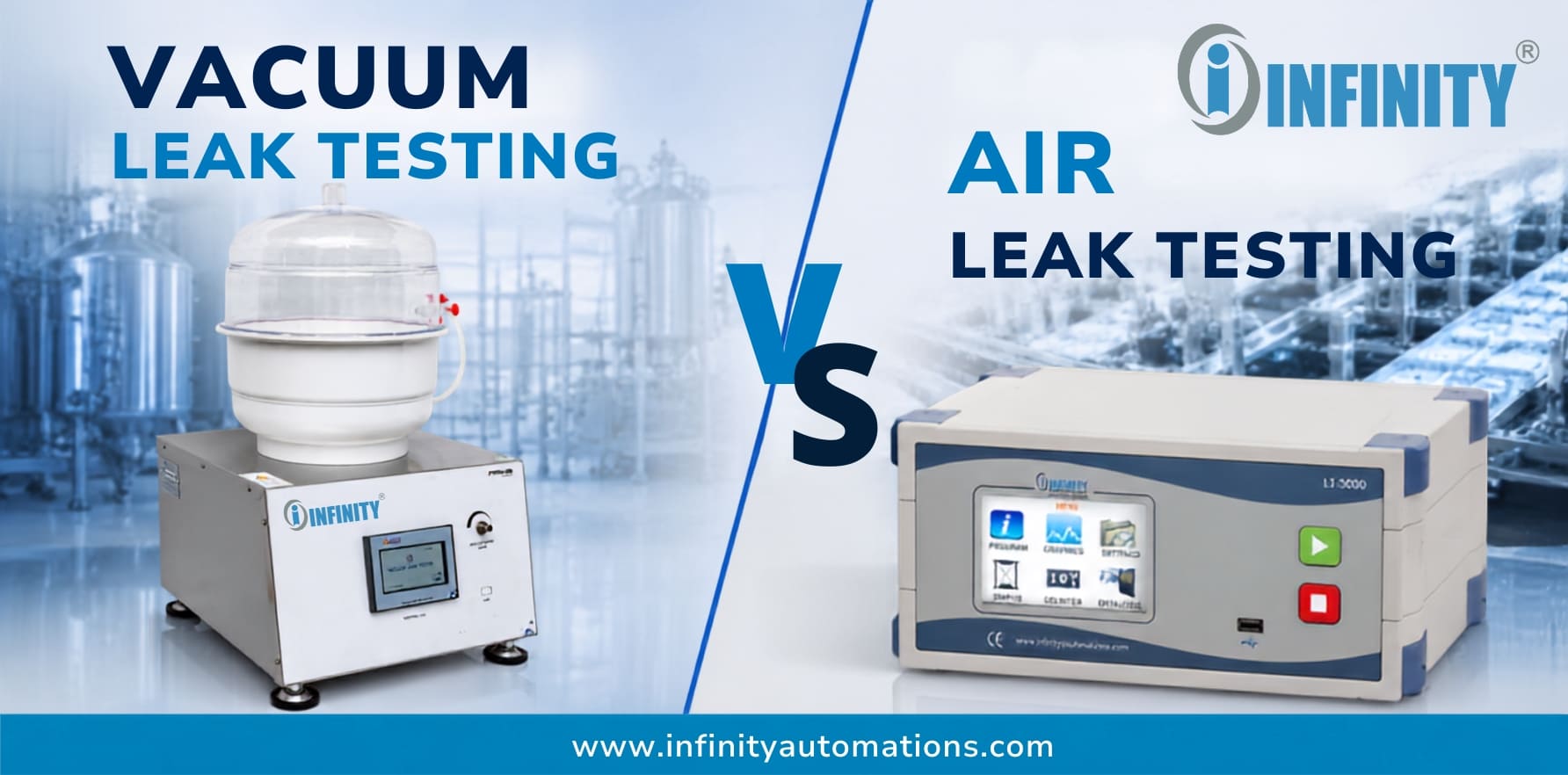
Vacuum Leak Testing uses negative pressure to detect leaks and is particularly suitable for flexible, sensitive or vacuum-compatible products. Air Leak Testing uses positive pressure and commonly measures pressure decay or airflow, making it well suited to rigid components and high-volume automated production. The right method depends on product material, leak sensitivity, operating conditions, production volume and required test speed.
In today's manufacturing environment, ensuring that products are completely leak-free is critical for maintaining quality, safety, and customer satisfaction. Industries such as automotive, medical devices, electronics, packaging, HVAC, and industrial manufacturing rely on advanced leak detection systems to verify the integrity of their products before they reach the market.
Among the most widely used Leak Detection Methods, Vacuum Leak Testing and Air Leak Testing are the two primary technologies used to detect leaks in sealed components. While both methods serve the same purpose—identifying unwanted leakage—they operate using different principles and are suitable for different products, materials, and production environments.
Choosing the wrong testing method can lead to inaccurate results, unnecessary production costs, increased rejection rates, or undetected product failures. Therefore, understanding the differences between these two techniques is essential before investing in a leak testing system.
This comprehensive guide compares Vacuum Leak Testing vs Air Leak Testing based on working principles, accuracy, speed, cost, advantages, disadvantages, applications, and selection criteria to help you determine the best solution for your manufacturing process.
What is Vacuum Leak Testing?
Vacuum Leak Testing is a non-destructive inspection method used to determine whether a product has leaks by creating a vacuum around or inside the test component. Instead of pressurizing the product with compressed air, the machine removes air to create negative pressure and monitors pressure changes or detects escaping gases.
A Vacuum Leak Test Machine is commonly used for products where applying positive pressure could damage the component or where extremely high sensitivity is required.
Vacuum leak testing is especially suitable for flexible packaging, medical devices, thin-walled plastic components, pharmaceutical packaging, electronics, and sensitive assemblies.
How Vacuum Leak Testing Works
A typical Vacuum Leak Testing cycle includes:
- Place the product inside the vacuum chamber.
- Seal the testing chamber.
- Create a controlled vacuum.
- Allow pressure stabilization.
- Measure pressure changes or observe leakage.
- Compare readings with acceptable limits.
- Display pass/fail results.
- Release vacuum and unload the product.
Advanced systems may also use tracer gases or helium for ultra-high sensitivity applications.
What is Air Leak Testing?
Air Leak Testing is one of the most common industrial leak detection methods. It verifies the sealing integrity of a product by introducing compressed air into the component and measuring pressure decay, airflow, or differential pressure over a specified period.
Unlike vacuum testing, air leak testing applies positive pressure inside the product.
It is widely used for automotive components, plastic welded parts, battery housings, valves, pumps, HVAC components, and industrial tanks.
How Air Leak Testing Works
The standard testing process includes:
- Load the component into a fixture.
- Seal all openings.
- Pressurize with compressed air.
- Stabilize the pressure.
- Measure pressure loss or airflow.
- Compare results with acceptance criteria.
- Generate pass/fail decision.
- Vent air and unload the product.
The most common industrial method is Pressure Decay Testing, which measures pressure loss over a defined period to detect leaks.
Working Principle Comparison
Vacuum Leak Testing
- Uses negative pressure (vacuum)
- Measures vacuum loss or pressure changes
- Product may be tested inside a sealed chamber
- Ideal for sensitive and flexible products
- Suitable for detecting very small leaks
Air Leak Testing
- Uses positive air pressure
- Measures pressure decay or airflow
- Product is pressurized internally
- Ideal for rigid components
- Suitable for high-volume manufacturing
Vacuum Leak Testing vs Air Leak Testing
Although both methods detect leaks, their performance differs depending on the application.
Testing Environment:-
1. Vacuum Leak Testing
The component is exposed to a vacuum environment, making it ideal for products that operate under vacuum conditions or cannot tolerate internal pressure.
2. Air Leak Testing
The product is internally pressurized, making it suitable for components designed to withstand operating pressure.
Product Compatibility:-
1. Vacuum Leak Testing
Best suited for flexible packaging, medical pouches, thin plastic containers, electronic housings, and pharmaceutical products.
2. Air Leak Testing
Best suited for plastic welded assemblies, automotive tanks, pumps, valves, pipes, battery enclosures, and industrial plastic products.
Accuracy Comparison
Accuracy is one of the most important factors when selecting a leak testing method.
Vacuum Leak Testing
Advantages include: Extremely sensitive, detects very small leaks, suitable for low-pressure products, and effective for flexible materials. However, environmental factors and chamber sealing quality can influence results.
Air Leak Testing
Modern Pressure Decay Testing systems provide excellent accuracy for most industrial applications.
Benefits include: High repeatability, stable measurements, excellent production consistency, easy calibration, and suitability for automated inspection.
For rigid products, air leak testing is often the preferred solution.
Speed Comparison
Vacuum Leak Testing
Typical cycle time: 10–40 seconds. Cycle time depends on chamber size, vacuum generation, stabilization period, and product volume.
Air Leak Testing
Typical cycle time: 3–20 seconds. Modern Air Leak Testing systems generally offer faster throughput, making them ideal for high-volume production.
Cost Comparison
Equipment Cost
Vacuum Leak Test Machine: Higher costs may result from vacuum chamber, vacuum pumps, specialized sealing systems, and vacuum sensors.
Air Leak Testing Machine: Typically includes pressure regulators, precision pressure sensors, pneumatic valves, PLC control, and test fixtures. For many industrial applications, air leak testing equipment offers a lower initial investment.
Operating Cost
Vacuum Leak Testing: Operating costs include vacuum pump maintenance, chamber seal replacement, and energy consumption.
Air Leak Testing: Operating costs generally include compressed air supply, sensor calibration, and pneumatic maintenance. Overall maintenance is often simpler and more economical.
Advantages of Vacuum Leak Testing
- Excellent sensitivity
- Suitable for flexible products
- Non-destructive testing
- Detects extremely small leaks
- Ideal for vacuum-operated products
- Good for pharmaceutical packaging
- Effective for medical devices
Disadvantages of Vacuum Leak Testing
- Higher equipment cost
- Longer testing cycles
- Vacuum chamber required
- Larger machine footprint
- More maintenance
- Less suitable for high-speed production
Advantages of Air Leak Testing
- Faster inspection cycles
- Lower operating cost
- High production throughput
- Easy automation
- Excellent repeatability
- Suitable for rigid products
- Lower maintenance
- Proven industrial reliability
Disadvantages of Air Leak Testing
- Less suitable for flexible packaging
- Internal pressure may not suit delicate products
- Fixture sealing is critical
- Compressed air quality affects accuracy
Industry Applications
Vacuum Leak Testing Applications
Widely used in medical device manufacturing, pharmaceutical packaging, flexible food packaging, cosmetic packaging, electronic components, laboratory testing, and research applications.
Explore Filter Integrity Tester for pharmaceutical applications
Air Leak Testing Applications
Commonly used in automotive manufacturing, EV battery packs, plastic welded products, pumps, valves, HVAC systems, fluid reservoirs, industrial tanks, and consumer appliances.
Learn more about Plastic Welding and leak testing
Vacuum Leak Testing vs Air Leak Testing: Comparison Table
| Feature | Vacuum Leak Testing | Air Leak Testing |
|---|---|---|
| Testing Principle | Negative Pressure | Positive Pressure |
| Common Method | Vacuum Chamber | Pressure Decay Testing |
| Product Type | Flexible Products | Rigid Products |
| Accuracy | Very High | Very High |
| Cycle Time | Moderate | Faster |
| Equipment Cost | Higher | Moderate |
| Maintenance | Moderate to High | Lower |
| Automation | Available | Excellent |
| Production Volume | Medium | High |
| Automotive Use | Limited | Excellent |
| Packaging | Excellent | Good |
| Plastic Welded Parts | Limited | Excellent |
| Medical Devices | Excellent | Excellent |
Which Method Should You Choose?
There is no single best leak detection method for every application. The right choice depends on your product design, production requirements, and quality expectations.
Choose Vacuum Leak Testing If:
- Products are flexible
- Extremely high sensitivity is required
- Testing pharmaceutical packaging
- Testing medical pouches
- Internal pressurization is not possible
- Product operates under vacuum conditions
Choose Air Leak Testing If:
- Products are rigid
- High production speed is required
- Testing plastic welded components
- Manufacturing automotive products
- Automated production lines are used
- Lower operating cost is important
Key Factors to Consider Before Selecting a Leak Detection Method
Before investing in leak testing equipment, evaluate:
- Product Material: Rigid plastic parts typically perform better with air leak testing, while flexible packaging often requires vacuum testing.
- Leak Sensitivity: Determine the smallest leak your application must detect and choose equipment capable of meeting that requirement.
- Production Volume: High-speed manufacturing environments generally benefit from air leak testing due to shorter cycle times.
- Automation Requirements: If the system must integrate with robots, conveyors, barcode scanners, or Manufacturing Execution Systems (MES), ensure the chosen solution supports automation.
- Operating Costs: Consider long-term expenses such as energy consumption, calibration, pump or compressor maintenance, replacement seals, and spare parts availability.
Future Trends in Leak Detection Methods
Leak testing technology continues to evolve with Industry 4.0 and smart manufacturing.
Emerging innovations include:
- AI-assisted leak analysis
- IoT-enabled remote monitoring
- Predictive maintenance
- Cloud-based quality reporting
- Automatic calibration
- Machine vision integration
- Robotic part handling
- Real-time production analytics
- Digital traceability
These advancements improve testing accuracy while reducing downtime and operational costs.
Why Choose Infinity Automation Systems for Leak Testing?
Infinity Automation Systems Private Limited develops industrial leak testing and automation solutions for manufacturing applications. Its leak testing portfolio includes Air Leak Testers, Differential Pressure/Vacuum Decay testing, blockage testing, volume testing and customized automated inspection systems.
Not Sure Which Leak Testing Method Your Product Needs?
Discuss your component, leak-rate requirement, test pressure, production volume and automation requirements with Infinity Automation Systems to identify a suitable leak testing approach.
Discuss Your Requirement → Explore Leak Testing Solutions →Conclusion
Both Vacuum Leak Testing and Air Leak Testing are highly effective Leak Detection Methods, but each is designed for different manufacturing needs. Choosing the right approach depends on the product's design, material, operating conditions, required leak sensitivity, and production volume.
Vacuum Leak Testing is ideal for flexible packaging, medical devices, pharmaceutical products, and applications where applying internal pressure is not practical. It offers excellent sensitivity and is particularly useful for detecting extremely small leaks in delicate products.
Air Leak Testing, especially using Pressure Decay Testing, remains the preferred choice for rigid components such as automotive parts, plastic welded assemblies, pumps, valves, and industrial products. It provides faster cycle times, lower operating costs, high repeatability, and easy integration with automated production lines.
Before investing in a Vacuum Leak Test Machine or an Air Leak Testing system, carefully assess your product requirements, quality standards, automation goals, and long-term operating costs. Selecting the appropriate leak testing solution will improve product reliability, reduce manufacturing defects, and support consistent quality across your production process.
Contact Infinity Automation Systems to discuss your leak testing requirements.
Frequently Asked Questions (FAQs)
Vacuum Leak Testing uses negative pressure to identify leaks, whereas Air Leak Testing uses positive pressure and typically measures pressure decay or airflow.
Both methods provide excellent accuracy when correctly configured. Vacuum Leak Testing is often preferred for highly sensitive or flexible products, while Air Leak Testing delivers outstanding repeatability for rigid industrial components.
Air Leak Testing generally offers shorter cycle times, making it more suitable for high-volume production environments.
Medical devices, pharmaceutical packaging, flexible packaging, electronics, and laboratory testing commonly rely on vacuum-based inspection.
For most rigid plastic welded components, Air Leak Testing with Pressure Decay Testing is a preferred solution because it offers high accuracy, fast cycle times, and integration with automated manufacturing systems.
Pressure Decay Testing is a leak detection method that pressurizes a component with air and measures the pressure loss over a defined period to identify leaks.
Yes. Vacuum Leak Testing is particularly suitable for flexible packaging, medical pouches, thin plastic containers and other products that may not tolerate internal positive pressure.
Yes. Air Leak Testing is well suited to automated production because it provides fast cycle times, repeatable measurements and integration capabilities for high-volume manufacturing.
The main factors include product material and flexibility, required leak sensitivity, operating pressure, production volume, required cycle time, automation requirements and long-term operating costs.
Yes, depending on the equipment configuration. Some leak testing systems support differential pressure decay measurement under both pressure and vacuum conditions.