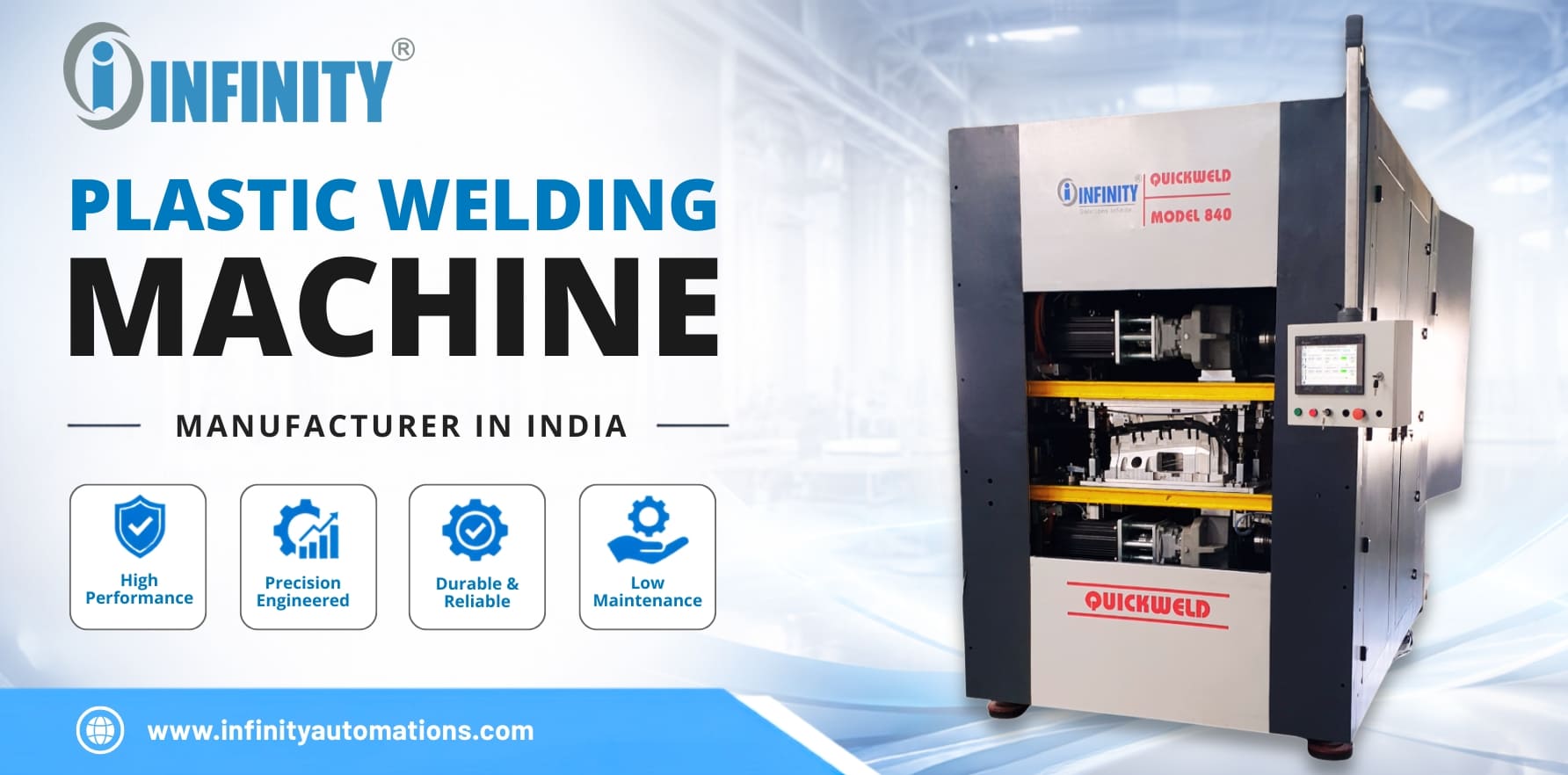
Plastic Welding Machine Manufacturer in India
What is a Plastic Welding Machine?
A Plastic Welding Machine is an industrial manufacturing system used to permanently join thermoplastic components using controlled heat, pressure, vibration, or laser technology. It creates strong, leak-proof, and durable joints without adhesives or mechanical fasteners. Plastic welding machines are widely used in automotive, medical, packaging, electronics, battery manufacturing, water tank production, and household appliance industries to improve product quality, production efficiency, and manufacturing consistency.
India's manufacturing sector is witnessing remarkable growth, driven by rapid industrialization, technological advancements, and the increasing demand for high-quality plastic components across industries. Sectors such as automotive, electric vehicles (EVs), medical devices, packaging, consumer goods, electronics, and household appliances are increasingly relying on precision-engineered plastic parts to manufacture lightweight, durable, and cost-effective products. As the use of thermoplastics continues to expand, manufacturers require joining technologies that deliver strong, leak-proof, and repeatable welds without compromising product quality.
This growing demand has made Plastic Welding Machines an essential part of modern industrial production. Unlike conventional joining methods such as adhesives, screws, or rivets, plastic welding creates permanent molecular bonds that offer superior strength, improved aesthetics, and excellent resistance to pressure, vibration, and environmental conditions. Whether manufacturing automotive fluid reservoirs, medical equipment, battery enclosures, water tanks, or electronic housings, reliable plastic welding ensures consistent product performance while reducing production time and operational costs.
However, selecting the right plastic welding machine is just as important as the welding process itself. Manufacturers today require automated, high-precision, and application-specific solutions that can integrate seamlessly into modern production lines while maintaining consistent quality and high throughput. Investing in reliable welding equipment not only improves production efficiency but also minimizes defects, reduces material waste, and supports long-term business growth.
As a trusted Plastic Welding Machine Manufacturer in India, Infinity Automation Systems delivers advanced industrial plastic welding solutions designed to meet the evolving needs of modern manufacturing. Our machines are engineered for precision, durability, and automation, helping manufacturers across diverse industries achieve superior weld quality, increased productivity, and dependable performance. Whether you require a standard machine or a fully customized automated welding system, Infinity Automation Systems provides end-to-end solutions tailored to your production requirements.
What is a Plastic Welding Machine?
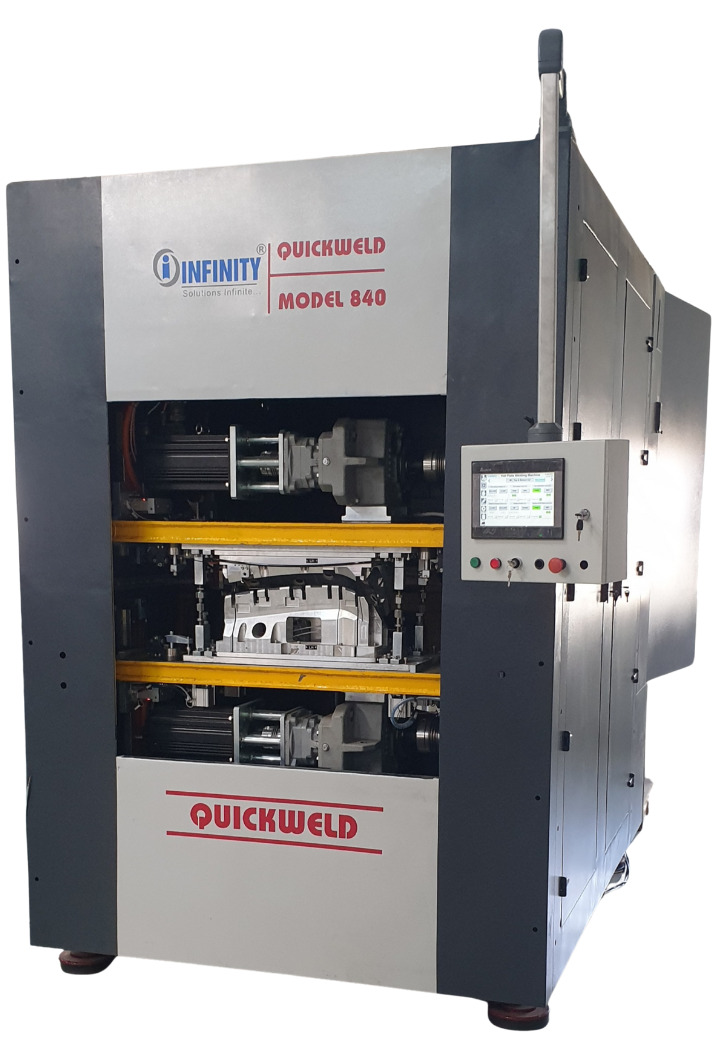
A Plastic Welding Machine is an industrial manufacturing system used to join two or more thermoplastic components by applying controlled heat, pressure, or friction to create a strong and permanent bond. Unlike adhesives or mechanical fasteners, plastic welding fuses the materials at a molecular level, producing durable, leak-proof joints without the need for additional joining materials. This process is widely used in industries where product strength, precision, and long-term reliability are essential.
The working principle of a plastic welding machine depends on the welding technology being used, such as hot plate, ultrasonic, vibration, infrared, spin, or laser welding. In most processes, the machine heats the mating surfaces of the plastic components until they reach the required melting temperature. The components are then pressed together under controlled pressure, allowing the molten material to fuse. As the joint cools, it forms a seamless and high-strength weld that becomes an integral part of the product.
Plastic welding is primarily used for thermoplastics, as these materials soften when heated and solidify upon cooling without losing their structural properties. This makes the process highly efficient, repeatable, and suitable for automated manufacturing environments.
Today, plastic welding machines are widely used across industries such as automotive, electric vehicles (EVs), medical devices, packaging, consumer products, electronics, household appliances, water storage tanks, and industrial equipment manufacturing. Compared to adhesives, screws, or rivets, plastic welding offers numerous advantages, including stronger joints, improved product aesthetics, faster production cycles, better sealing performance, reduced material costs, and enhanced manufacturing consistency.
Key Features of a Modern Plastic Welding Machine
Ensures accurate and repeatable weld quality.
Simplifies machine operation and process monitoring.
Provides precise pressure and positioning.
Supports Hot Plate, Ultrasonic, Spin, Infrared, and more.
Designed for different product geometries.
Improves production output.
Optimized heating and motion control reduce operating costs.
Supports MES, ERP, IoT, and production traceability.
Types of Plastic Welding Machines
Plastic welding machines are available in various configurations, each designed for specific materials, product geometries, and manufacturing requirements. Selecting the right welding technology depends on factors such as joint design, production volume, weld strength, and application.
1. Hot Plate Welding Machine
Joins thermoplastic components by heating the mating surfaces with a temperature-controlled hot plate. Once the plastic reaches the required melting point, the hot plate retracts, and the components are pressed together to form a strong, permanent bond.
Applications: Automotive fluid reservoirs, water tanks, battery housings, air ducts, and industrial containers.
Advantages: High weld strength, excellent sealing performance, and suitable for large or complex plastic components.
Best Industries: Automotive, water storage, industrial equipment, and household appliances.
2. Hot Gas Welding Machine
Uses a stream of heated air or inert gas to soften plastic surfaces while simultaneously applying a compatible welding rod to create a durable joint.
Applications: Plastic tanks, pipes, ducts, repair work, and custom plastic fabrication.
Advantages: Portable, flexible, and ideal for on-site repairs or low-volume production.
Best Industries: Chemical processing, fabrication, water treatment, and construction.
3. Ultrasonic Plastic Welding Machine
Generates high-frequency vibrations that produce frictional heat at the joint interface, melting the plastic within seconds without requiring external heat sources.
Applications: Medical devices, automotive sensors, electrical connectors, electronic housings, and consumer products.
Advantages: Extremely fast cycle times, clean welds, energy-efficient operation, and excellent repeatability.
Best Industries: Medical, electronics, automotive, and consumer goods manufacturing.
4. Spin Welding Machine
Joins circular plastic components by rotating one part against another under controlled pressure. The friction generated during rotation melts the contact surfaces, creating a strong weld as the material cools.
Applications: Filters, reservoirs, valves, fluid containers, and cylindrical plastic assemblies.
Advantages: Strong leak-proof joints, short production cycles, and high process consistency.
Best Industries: Automotive, filtration, packaging, and fluid handling equipment.
5. Infrared Plastic Welding Machine
Uses infrared radiation to heat plastic surfaces without direct contact. Once the required temperature is achieved, the components are pressed together to form a clean and precise weld.
Applications: Automotive lighting, battery enclosures, electronic housings, and precision plastic assemblies.
Advantages: No contamination from heating elements, minimal particle generation, and excellent weld quality for complex components.
Best Industries: Automotive, electronics, EV battery manufacturing, and medical devices.
6. Laser Plastic Welding Machine
Employs a focused laser beam to transmit heat through a laser-transparent plastic layer and weld it to an absorbent plastic component. This process delivers highly accurate and localized heating.
Applications: Medical instruments, electronic sensors, automotive components, and micro-precision plastic assemblies.
Advantages: Exceptional precision, minimal thermal distortion, clean aesthetics, and suitability for automated production lines.
Best Industries: Medical technology, electronics, automotive, and high-precision manufacturing.
7. Vibration Welding Machine
Creates heat through controlled linear vibration between two plastic components under pressure. The friction melts the contact surfaces, resulting in a robust molecular bond after cooling.
Applications: Automotive intake manifolds, dashboards, battery housings, appliance components, and large plastic assemblies.
Advantages: Suitable for large and irregularly shaped parts, high weld strength, and excellent productivity for mass production.
Best Industries: Automotive, household appliances, industrial manufacturing, and consumer products.
Plastic Welding vs Traditional Joining Methods
| Feature | Plastic Welding | Adhesives | Screws/Rivets |
|---|---|---|---|
| Joint Strength | Excellent | Medium | High |
| Leak Proof | Yes | Limited | No |
| Production Speed | High | Medium | Low |
| Appearance | Clean | Adhesive marks | Visible fasteners |
| Automation | Easy | Limited | Moderate |
| Maintenance | Low | Medium | Medium |
Industrial Applications of Plastic Welding Machines
Plastic welding machines have become an integral part of modern manufacturing, enabling industries to produce durable, leak-proof, and high-quality plastic components with exceptional precision.
- Automotive Industry – Fuel tanks, coolant reservoirs, intake manifolds, washer fluid tanks, air ducts, headlamp assemblies, battery housings, and interior trim components.
- Medical Devices – IV fluid containers, blood filters, diagnostic cartridges, surgical instruments, respiratory devices, catheters, and laboratory equipment.
- Packaging Industry – Food containers, cosmetic packaging, pharmaceutical packaging, industrial chemical containers, and flexible packaging assemblies.
- Water Tank Manufacturing – Water storage tanks, chemical tanks, agricultural tanks, septic tanks, and industrial containers.
- Consumer Goods – Luggage, furniture, toys, storage boxes, sports equipment, plastic tool cases, and personal care products.
- Electronics Industry – Electrical connectors, switch housings, smart meters, sensors, battery chargers, control panels, and electronic device enclosures.
- Battery Manufacturing – EV battery enclosures, battery modules, cooling system components, cell holders, and battery covers.
- Household Appliances – Washing machines, refrigerators, vacuum cleaners, water purifiers, air conditioners, kitchen appliances, and small domestic devices.
Major Benefits at a Glance
Creates permanent, high-strength joints by fusing thermoplastic materials at the molecular level.
Ideal for applications requiring airtight or watertight performance.
High-speed welding processes improve productivity and reduce manufacturing lead times.
Automated welding minimizes manual intervention, reducing labor costs and human errors.
Every weld is produced with consistent quality, ensuring uniform products throughout large production batches.
Robust machine construction and durable components reduce maintenance requirements and machine downtime.
Precise control of heat and pressure minimizes scrap, lowering production costs.
Modern servo-driven systems consume power only when required, improving energy efficiency.
Machines integrate seamlessly with PLCs, robotics, conveyors, and vision inspection systems.
Eliminates visible screws, rivets, or adhesives, resulting in clean and professional-looking products.
Lower operating costs, higher production output, and reduced product defects deliver long-term financial benefits.
Automated systems maintain high-speed production while ensuring consistent weld quality.
How to Choose the Right Plastic Welding Machine
Selecting the right Plastic Welding Machine is one of the most important decisions for manufacturers looking to improve production efficiency and product quality. Every application has unique requirements, and choosing the appropriate machine ensures reliable performance, lower operating costs, and long-term return on investment.
- Material Type – Different thermoplastics have different melting temperatures and welding characteristics. Ensure the selected machine is compatible with materials such as PP, PE, ABS, PVC, Nylon, or Polycarbonate.
- Product Size and Geometry – Small precision components may require ultrasonic or laser welding, whereas large products such as water tanks or automotive reservoirs are better suited for hot plate or vibration welding.
- Joint Design – The strength and quality of the weld depend on the design of the joint. Flat, circular, or complex geometries may require different welding technologies.
- Production Volume – For low-volume production, semi-automatic systems may be sufficient. High-volume manufacturing benefits from fully automated plastic welding machines integrated into production lines.
- Required Cycle Time – Manufacturers with high production targets should prioritize machines capable of delivering shorter welding cycles without compromising weld quality.
- Automation Requirements – Modern manufacturing environments often require PLC controls, HMI interfaces, robotic loading, barcode traceability, and Industry 4.0 connectivity.
- Budget and Total Cost of Ownership – Instead of focusing solely on purchase price, consider operating costs, maintenance expenses, energy consumption, and expected machine lifespan.
- Future Scalability – Choose equipment that can accommodate future production expansion, additional product variants, or automation upgrades.
- Industry Standards – Ensure the machine complies with applicable industry standards and quality requirements for your manufacturing sector.
- After-Sales Support – Reliable technical support, spare parts availability, operator training, and preventive maintenance services are essential for long-term operational success.
Factors to Consider Before Buying a Plastic Welding Machine
Before investing in a plastic welding machine, manufacturers should compare suppliers based on technical capabilities as well as long-term support.
- Production Capacity – Can the machine meet your daily production requirements?
- Suitable Welding Technology – Select Hot Plate, Ultrasonic, Spin, Infrared, Laser, or Vibration Welding based on your application.
- Machine Footprint – Ensure the equipment fits within your existing production layout.
- Power Consumption – Choose energy-efficient machines to reduce operational costs.
- PLC Compatibility – Verify compatibility with existing automation systems and manufacturing software.
- Spare Parts Availability – Ensure genuine replacement parts are readily available.
- Service & Technical Support – Choose a manufacturer with responsive after-sales service.
- Operator Training – Proper training improves productivity and reduces operational errors.
- Safety Features – Look for emergency stops, safety guards, sensors, and compliance with industrial safety standards.
- Warranty & AMC – Evaluate warranty coverage and the availability of Annual Maintenance Contracts (AMC) for long-term machine reliability.
Why Plastic Welding is Replacing Traditional Assembly Methods
- Faster Manufacturing – Plastic welding significantly reduces assembly time by eliminating curing processes, drilling, or manual fastening.
- Stronger Joints – The molecular bonding created during welding produces stronger and more durable joints than many conventional joining methods.
- Better Product Aesthetics – Plastic welding creates seamless joints without visible screws, rivets, or adhesive marks, improving the appearance of finished products.
- Reduced Material Costs – Since no additional fasteners or adhesives are required, manufacturers reduce both material consumption and assembly costs.
- Leak-Proof Performance – Plastic welding creates airtight and watertight seals, making it ideal for fluid reservoirs, battery housings, medical devices, and packaging applications.
- Easier Automation – Plastic welding integrates easily with robotic handling systems, conveyors, vision inspection, and PLC-controlled production lines, making it suitable for Industry 4.0 manufacturing.
- Higher Productivity – Short welding cycles, automated operation, and reduced rework allow manufacturers to achieve higher production output while maintaining consistent product quality.
Why Choose Infinity Automation Systems as a Plastic Welding Machine Manufacturer in India?
Choosing the right plastic welding machine manufacturer is essential for achieving consistent product quality, higher productivity, and long-term operational reliability. At Infinity Automation Systems, we combine engineering expertise, advanced automation technologies, and customer-focused solutions to deliver high-performance plastic welding machines tailored to modern manufacturing needs. As a trusted Plastic Welding Machine Manufacturer in India, we help businesses across multiple industries enhance their production processes with precision-engineered and future-ready welding solutions.
We understand that every manufacturing application is unique. That's why we design customized plastic welding solutions based on your product specifications, material type, production capacity, and quality requirements. Whether you need a standalone machine or a fully automated production line, our team develops systems that seamlessly fit your manufacturing environment.
Our portfolio includes industry-specific machines for automotive, electric vehicles (EVs), medical devices, packaging, electronics, water tank manufacturing, consumer goods, and household appliances. Every solution is engineered to deliver strong, consistent, and leak-proof welds while maximizing production efficiency.
With extensive automation expertise, Infinity Automation Systems integrates advanced PLC-based controls, servo-controlled systems, HMI interfaces, barcode traceability, and robotic compatibility to support Industry 4.0-ready manufacturing. These intelligent systems ensure precise process control, repeatable welding quality, and reduced manual intervention.
Every machine undergoes rigorous quality testing before delivery to ensure reliable performance, durability, and compliance with industrial standards. Beyond installation, we provide comprehensive after-sales support, including preventive maintenance, technical assistance, troubleshooting, and prompt service to minimize production downtime.
Our services extend across PAN India, with professional installation, machine commissioning, and operator training to help customers achieve maximum productivity from day one. We also maintain the availability of genuine spare parts and technical support to ensure uninterrupted machine performance throughout its lifecycle.
Address: S No. 80/2A, Mumbai Bangalore Bypass Highway, Near JSPM Engineering College, Ashok Nagar, Tathawade, Pune – 411033, Maharashtra, India
Phone: +91 93256 40283 / +91 93256 40285 / +91 93256 40287
Email: sales@infinityautomations.com
Website: https://www.infinityautomations.com
Future of Plastic Welding Automation
The future of Plastic Welding Machines is being shaped by Industry 4.0, where intelligent automation, digital connectivity, and real-time data are transforming traditional manufacturing into smart, efficient production environments. Modern manufacturers are increasingly adopting automated plastic welding systems that improve productivity, ensure consistent quality, and reduce operational costs while supporting high-volume production.
In smart factories, plastic welding machines are integrated with Programmable Logic Controllers (PLCs), Manufacturing Execution Systems (MES), and Enterprise Resource Planning (ERP) software to enable seamless communication across the production line. This connectivity allows manufacturers to monitor machine performance, optimize production schedules, and maintain complete process traceability.
The adoption of AI-powered monitoring is helping manufacturers analyze welding parameters, identify process variations, and detect potential quality issues before they affect production. IoT-enabled plastic welding machines continuously collect operational data, allowing remote monitoring, performance analysis, and faster decision-making.
Advanced systems also support predictive maintenance, using real-time machine data to identify component wear and schedule maintenance before unexpected failures occur. This minimizes downtime, extends machine life, and improves overall equipment effectiveness (OEE).
To further increase efficiency, many manufacturers are integrating robotic welding systems for automatic loading, unloading, and precision part handling. Combined with vision inspection systems, these machines can verify component positioning, inspect weld quality, and automatically reject defective parts without manual intervention.
Additionally, comprehensive data logging capabilities record welding parameters, production history, operator details, and quality reports for every component. This improves traceability, supports regulatory compliance, and enables continuous process improvement, making plastic welding automation a key driver of the future of smart manufacturing.
Looking for a Plastic Welding Machine Manufacturer in India?
Contact Infinity Automation Systems today to discuss your manufacturing requirements, request a customized quotation, or schedule a live machine demonstration with our technical experts.
Contact Infinity Automation Systems →Conclusion
As industries continue to embrace automation and precision manufacturing, Plastic Welding Machines have become a vital part of producing high-quality, durable, and leak-proof thermoplastic components. Whether manufacturing automotive parts, medical devices, battery enclosures, packaging products, electronics, or household appliances, the right plastic welding solution enhances product reliability, increases production efficiency, and reduces overall manufacturing costs.
At Infinity Automation Systems, we go beyond supplying machines—we provide complete automation solutions designed to support your long-term manufacturing success.
Infinity Automation Systems helps manufacturers with:
- Customized Plastic Welding Machines
- Fully Automated Production Systems
- PLC & Servo-Controlled Integration
- Industrial Robotics Compatibility
- Quality Inspection & Testing Solutions
- Machine Installation & Commissioning
- PAN India Technical Support
- Annual Maintenance Contracts (AMC)
- Genuine Spare Parts Availability
- Operator Training & Process Optimization
Whether you're planning to upgrade an existing production line or invest in a new automated plastic welding solution, Infinity Automation Systems has the expertise to deliver a system tailored to your application.
Frequently Asked Questions (FAQs)
A Plastic Welding Machine is an industrial machine that joins thermoplastic components using controlled heat, pressure, vibration, or friction. It creates permanent molecular bonds that are stronger, cleaner, and more durable than conventional joining methods such as adhesives or mechanical fasteners.
Plastic Welding Machines are extensively used in Automotive Industry, Electric Vehicle Manufacturing, Medical Devices, Packaging Industry, Electronics Manufacturing, Water Tank Manufacturing, Consumer Products, Household Appliances, and Industrial Plastic Fabrication.
There is no single best method. The ideal welding technology depends on your product and application. Hot Plate Welding is ideal for large plastic parts, Ultrasonic Welding for precision components, Spin Welding for circular products, Infrared Welding for high-quality sealed assemblies, Laser Welding for medical & electronics, and Vibration Welding for automotive components.
Automatic Plastic Welding Machines offer several benefits: Faster production cycles, Consistent weld quality, Reduced labor costs, Higher productivity, Improved product reliability, Better repeatability, Industry 4.0 compatibility, Lower material waste, Reduced operational costs, and Easy robotic integration.
Consider the following factors: Plastic material, Product dimensions, Joint design, Required production capacity, Welding technology, Automation requirements, Machine flexibility, Budget, After-sales support, and Spare parts availability. Consulting an experienced manufacturer ensures you select the most suitable solution.