Plastic Welding Machine: Working Principle, Benefits, Materials & Applications
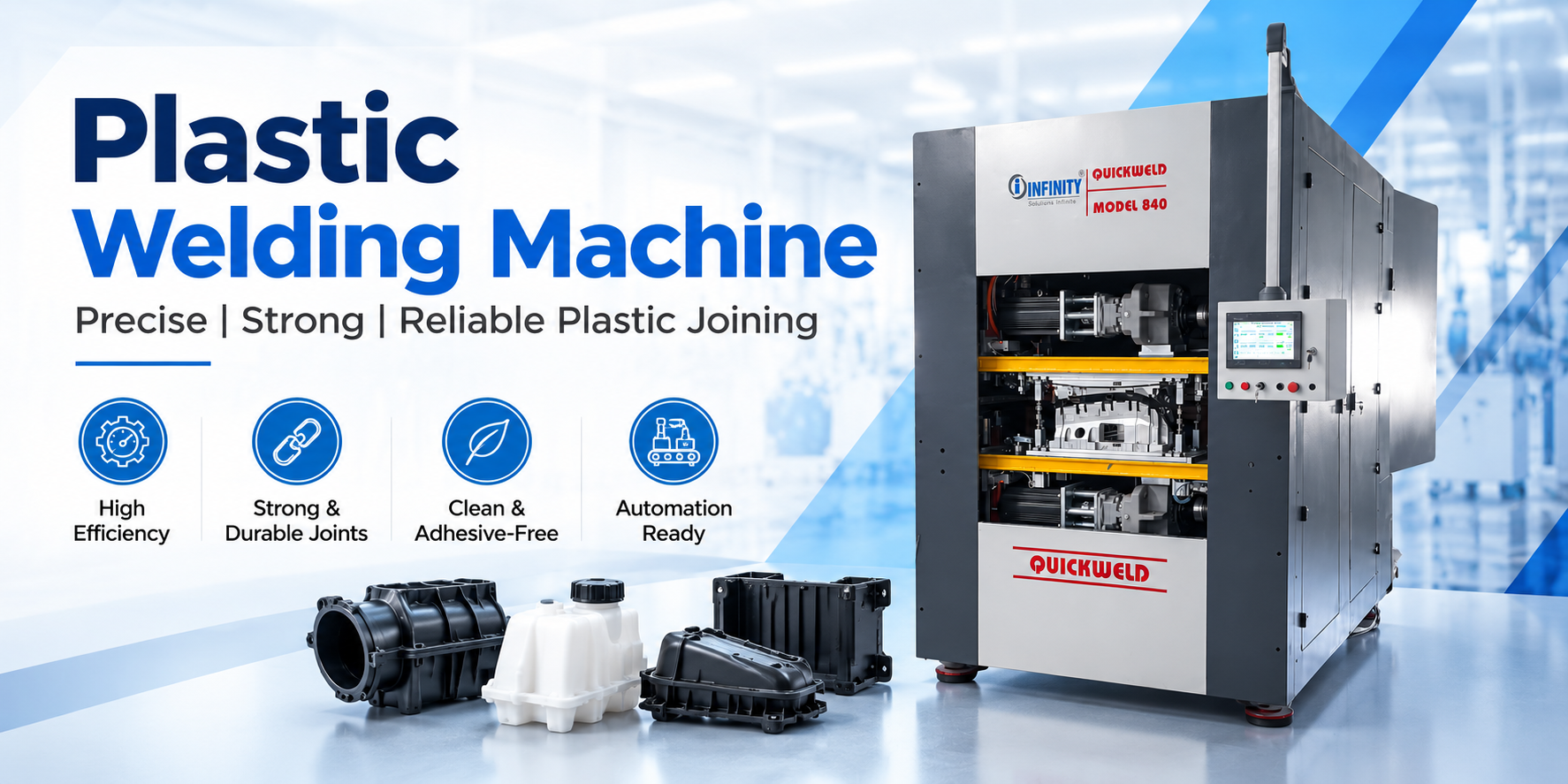
A plastic welding machine is an industrial joining system used to create strong and repeatable joints between compatible thermoplastic components. Depending on the material, component geometry, weld area and production requirements, manufacturers can use technologies such as ultrasonic, hot plate, vibration, spin, infrared and laser plastic welding.
Plastic components are widely used in automotive, electronics, packaging, medical, consumer-product and industrial manufacturing. As production requirements become more demanding, manufacturers need joining processes that can deliver accuracy, consistency, speed and dependable weld quality.
Among modern joining methods, ultrasonic plastic welding is especially useful for suitable thermoplastic applications because it uses high-frequency mechanical vibrations to generate localized heat at the joining interface. This can create a clean and repeatable bond without relying on adhesives, screws or other mechanical fasteners.
This guide explains what a plastic welding machine is, how ultrasonic plastic welding works, which materials can be considered, the major benefits and applications, and the factors manufacturers should evaluate before selecting plastic welding equipment.
What Is a Plastic Welding Machine?
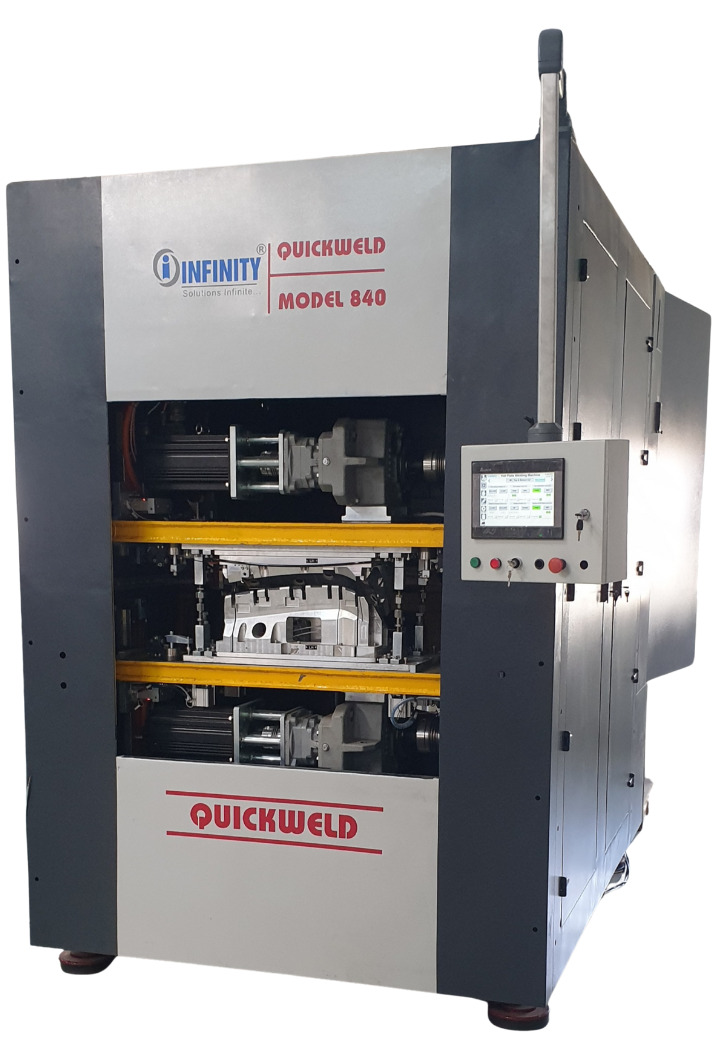
A plastic welding machine joins compatible thermoplastic components by applying controlled energy, pressure and movement at the intended joint.
Unlike adhesive assembly, plastic welding can create a permanent joint without adding a separate bonding material. The exact welding process depends on the selected technology and the design of the plastic components.
For automated manufacturing, the machine can be combined with fixtures, pneumatic or servo actuation, PLC controls, HMI systems, sensors, inspection systems and other production-line equipment.
How Does Ultrasonic Plastic Welding Work?
Ultrasonic plastic welding uses high-frequency mechanical vibrations to generate localized heat at the interface between compatible thermoplastic parts. The process is designed to concentrate energy at the intended joint rather than heating the entire component.
- Component positioning: The plastic parts are accurately positioned in a suitable fixture.
- Clamping: Controlled pressure holds the components together during the welding cycle.
- Ultrasonic energy: A transducer and horn transfer high-frequency mechanical vibrations to the joint area.
- Localized heating: Friction at the interface generates heat and softens the thermoplastic material.
- Joint formation: Controlled pressure allows the softened surfaces to form the required bond.
- Cooling: After the energy cycle ends, the joint solidifies while the components remain properly positioned.
The actual welding parameters should be developed and validated according to the material, component design, tooling and required weld performance.
Plastic Welding Technologies
There is no single plastic welding technology that is suitable for every component. The appropriate process depends on material, geometry, weld size, production volume, required strength, appearance and sealing requirements.
Ultrasonic Welding
Ultrasonic welding uses high-frequency mechanical vibrations to generate localized heat at the joining interface. It is well suited to many small and medium thermoplastic assemblies where speed, repeatability and clean joining are important.
Hot Plate Welding
Hot plate welding uses a temperature-controlled heated platen to soften mating plastic surfaces before the components are pressed together. It is particularly useful for suitable larger components and applications requiring strong, sealed joints. Explore Infinity's hot plate welding machine solution for more information.
Vibration Welding
Vibration welding creates frictional heat by moving one plastic component relative to another. It can be considered for larger thermoplastic assemblies where the component design is compatible with the process.
Spin Welding
Spin welding uses rotational movement between suitable plastic components to generate frictional heat. It can be useful for cylindrical or rotationally symmetric parts.
Infrared Welding
Infrared welding heats plastic surfaces without direct contact between the heater and the components. It can be considered where controlled heating and a clean joining process are important.
Laser Plastic Welding
Laser plastic welding uses laser energy to create a localized weld between suitable plastic components. It can provide precise joining and is useful for applications where controlled energy delivery and appearance are important.
For a deeper explanation of hot plate technology, see Infinity's guide to the hot plate welder working principle and applications.
Compatible Materials for Plastic Welding
Material compatibility is one of the most important factors when selecting a plastic welding process. The material grade, additives, reinforcement, moisture condition, component design and welding technology can all affect the final result.
- PVC: Used in a wide range of industrial and manufactured plastic products. Welding suitability depends on the material grade and process.
- UPVC: A rigid thermoplastic used in applications where dimensional stability and chemical resistance are important.
- ABS: Common in consumer products, electrical housings, automotive parts and industrial components.
- PP: A lightweight thermoplastic used extensively in packaging, automotive and industrial applications.
- PC: A strong engineering thermoplastic used in applications requiring impact resistance and dimensional performance.
- Nylon and other engineering thermoplastics: May also be suitable for specific welding applications after material and process evaluation.
Advantages of Plastic Welding Machines
Suitable plastic welding processes can provide short cycle times and support high-throughput manufacturing.
Ultrasonic welding can join suitable thermoplastics without adhesives or solvents.
Controlled process parameters can help manufacturers maintain consistent weld quality.
Welding equipment can be integrated with PLCs, robots, conveyors, sensors and inspection systems.
Plastic welding can reduce the need for separate adhesives, screws and other joining consumables in suitable applications.
When material, tooling and process parameters are correctly matched, welding can produce durable thermoplastic joints.
Applications of Plastic Welding Machines
Plastic welding technology can be used across many manufacturing sectors where thermoplastic components require permanent joining.
- Automotive: Suitable housings, ducts, reservoirs, lighting components and other thermoplastic assemblies.
- Electronics: Housings, connectors, enclosures and selected plastic assemblies.
- Medical and healthcare: Selected thermoplastic components where controlled, clean joining is required.
- Packaging: Suitable plastic containers, closures and packaging assemblies.
- Consumer products: Appliances, household products and plastic housings.
- Industrial manufacturing: Plastic components, enclosures and assemblies requiring repeatable joining.
Infinity also works across manufacturing applications involving turnkey assembly automation, helping manufacturers connect individual processes into efficient production systems.
Factors to Consider When Choosing a Plastic Welding Machine
Selecting the right equipment should start with the application rather than the machine alone. Consider the following factors:
- Material compatibility: Confirm that the material and grade are suitable for the selected welding process.
- Component geometry: Evaluate dimensions, joint design, weld area, wall thickness and accessibility.
- Required weld strength: Define the mechanical, sealing and durability requirements of the final assembly.
- Production volume: High-volume manufacturing may require automated loading, process control and data collection.
- Cycle time: Select a process capable of achieving the required production output without compromising weld quality.
- Automation requirements: Consider PLC, HMI, robotics, sensors, conveyors, vision inspection and traceability requirements.
- Tooling: Welding horns, fixtures and component supports should be designed for the specific application.
- After-sales support: Technical support, training, spare parts and process assistance can be important for long-term production reliability.
Plastic Welding Machine vs. Adhesive and Mechanical Fastening
| Factor | Plastic Welding | Adhesive Joining | Mechanical Fastening |
|---|---|---|---|
| Separate bonding material | Not normally required | Required | Not normally required |
| Fasteners | Not normally required | Not normally required | Required |
| Automation | Highly suitable | Suitable | Suitable |
| Process consistency | High when properly controlled | Process dependent | Process dependent |
| Best suited to | Compatible thermoplastics | Selected material combinations | Broad mechanical assemblies |
The best joining method depends on the application. Material compatibility, component geometry, production volume, cost, appearance and performance requirements should all be evaluated before selecting a process.
How Infinity Automations Can Support Plastic Welding Applications
Infinity Automation Systems develops industrial automation and plastic welding solutions for manufacturing applications. Depending on the project, a solution can be designed around the component, material, production target and required level of automation.
Potential solution elements can include plastic welding equipment, precision fixtures, PLC and HMI controls, servo-controlled movement, automated loading, inspection and integration with other manufacturing processes.
For applications where welded components also require quality verification, plastic welding can be combined with suitable leak testing solutions.
Looking for the Right Plastic Welding Solution?
Share your material, component drawing, weld area, production volume and required cycle time with Infinity Automation Systems to discuss a suitable plastic welding and automation approach.
Discuss Your Requirement → Explore Plastic Welding →Conclusion
A plastic welding machine can provide manufacturers with an efficient and repeatable way to join compatible thermoplastic components. Ultrasonic plastic welding is particularly useful for suitable applications where fast cycle times, controlled joining and automation are important.
However, selecting the right welding technology requires more than comparing machine specifications. Material compatibility, component geometry, joint design, tooling, weld strength, production volume, cycle time and automation requirements should all be considered.
By evaluating the complete application and matching the process to the component, manufacturers can build a more reliable plastic joining operation and improve production consistency.
Explore Infinity's plastic welding solutions or contact the team to discuss your application.
Frequently Asked Questions (FAQs)
A plastic welding machine is equipment used to join compatible thermoplastic components using a controlled welding process such as ultrasonic, hot plate, vibration, spin, infrared or laser welding.
Ultrasonic welding uses high-frequency mechanical vibrations to generate localized heat at the interface between suitable thermoplastic components, allowing the parts to form a controlled joint.
Suitable applications can include materials such as ABS, PVC, UPVC, PP, PC, nylon and other thermoplastics. Suitability depends on the material grade, component design and welding technology.
Ultrasonic plastic welding generally does not require adhesive or solvent for joining compatible thermoplastic components.
Yes. Plastic welding equipment can be integrated with PLCs, HMI systems, robots, conveyors, sensors, inspection systems and other production-line equipment.
Evaluate material compatibility, component geometry, joint design, required weld strength, cycle time, production volume, tooling, automation requirements and after-sales support.
Benefits can include fast joining, repeatable weld quality, reduced use of joining consumables, clean assembly and compatibility with automated production systems for suitable applications.
Yes. Plastic welding systems can be integrated with suitable leak-testing equipment when the finished component requires leak or sealing verification.