CCIT Testing Methods Explained: Deterministic vs Probabilistic Methods
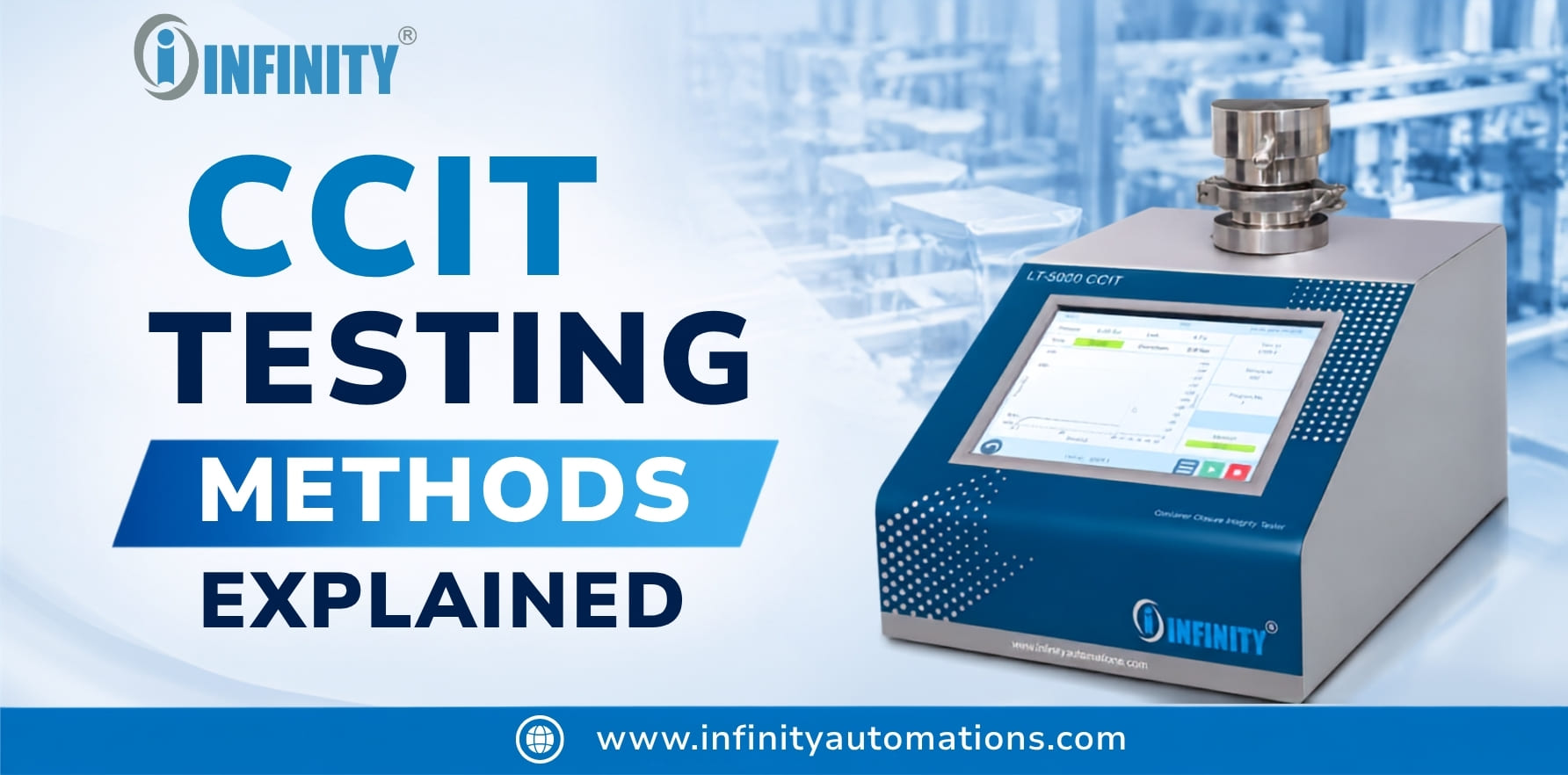
CCIT Testing Methods are techniques used to verify the integrity of pharmaceutical container closure systems and confirm that packaging maintains its sterile barrier. Deterministic methods such as Vacuum Decay, Pressure Decay, HVLD and Helium Leak Testing use measurable physical principles, while probabilistic methods such as Dye Ingress, Bubble Emission and Microbial Ingress rely more heavily on visual or statistical evaluation.
In the pharmaceutical and biotechnology industries, maintaining the sterility of injectable drugs is one of the most critical quality requirements. Sterile products such as vials, ampoules, cartridges, pre-filled syringes (PFS), blow-fill-seal (BFS) containers, and infusion bags must remain free from microbial contamination throughout their shelf life.
Even microscopic defects in the container closure system can compromise product sterility, leading to contamination, reduced product efficacy, regulatory non-compliance, expensive recalls, and potential risks to patient safety.
To verify the integrity of these packaging systems, manufacturers rely on Container Closure Integrity Testing (CCIT). Today, CCIT Testing Methods are recognized by regulatory agencies worldwide as essential quality assurance tools throughout pharmaceutical manufacturing.
This comprehensive guide explains the different CCIT Testing Methods, compares Deterministic CCIT and Probabilistic CCIT, explores technologies such as Vacuum Decay Testing, Pressure Decay Testing, High Voltage Leak Detection (HVLD), Helium Leak Testing, and Dye Ingress Testing, and discusses regulatory guidance to help manufacturers choose the most appropriate testing method.
What is CCIT?
Container Closure Integrity Testing (CCIT) is a non-destructive or destructive testing process used to verify whether a pharmaceutical container closure system maintains a sterile barrier throughout the product's intended shelf life.
CCIT evaluates whether defects such as cracks, pinholes, incomplete seals, stopper misalignment, or microscopic leaks are present in the packaging system.
Products commonly tested include glass vials, ampoules, pre-filled syringes, Blow-Fill-Seal (BFS) containers, IV bags, cartridges, plastic pharmaceutical containers, and lyophilized drug packaging.
Why Container Closure Integrity Matters
Sterile pharmaceutical products are vulnerable to contamination if packaging integrity is compromised.
Potential consequences include:
- Microbial contamination
- Product degradation
- Loss of sterility
- Regulatory action
- Product recalls
- Financial losses
- Patient safety risks
CCIT helps manufacturers ensure that every package maintains a reliable sterile barrier throughout storage, transportation, and use.
Types of CCIT Testing Methods
Modern CCIT Testing Methods are generally classified into two categories:
- Deterministic CCIT Methods
- Probabilistic CCIT Methods
Regulatory agencies increasingly recommend deterministic methods because they provide greater sensitivity, repeatability, and quantitative results.
Deterministic vs Probabilistic Methods
Deterministic CCIT
Deterministic methods use measurable physical principles to detect leaks objectively.
Characteristics include:
- Quantitative results
- High sensitivity
- Excellent repeatability
- Non-destructive testing (most methods)
- Automation compatibility
- Reduced operator dependency
Probabilistic CCIT
Probabilistic methods depend more heavily on visual observation or statistical interpretation.
Characteristics include:
- Subjective evaluation
- Lower repeatability
- Greater operator dependency
- Often destructive
- Lower sensitivity compared to deterministic methods
Deterministic CCIT Methods
Deterministic technologies have become the preferred choice for modern pharmaceutical manufacturing.
Common deterministic methods include:
- Vacuum Decay Testing
- Pressure Decay Testing
- High Voltage Leak Detection (HVLD)
- Helium Leak Testing
- Laser-based headspace analysis (for specific applications)
Vacuum Decay Testing
What is Vacuum Decay Testing?
Vacuum Decay Testing is one of the most widely accepted deterministic CCIT methods. The package is placed inside a sealed vacuum chamber where negative pressure is applied. Any leak causes measurable pressure changes within the chamber.
Working Principle
- Product is placed inside the chamber.
- Chamber is sealed.
- Vacuum is generated.
- Pressure stabilizes.
- Sensors monitor pressure changes.
- Software evaluates leak rate.
- Pass/fail result is generated.
Advantages
- Non-destructive
- Highly sensitive
- Fully automated
- Excellent repeatability
- Suitable for glass and plastic containers
- Regulatory acceptance
Applications
- Glass vials
- IV bags
- Cartridges
- Plastic bottles
- BFS containers
Learn about Vacuum Decay for Single-Use Bags
Pressure Decay Testing
What is Pressure Decay Testing?
Pressure Decay Testing measures pressure loss from a sealed container after pressurization. This method is commonly used for rigid containers and certain pharmaceutical packaging systems.
Advantages
- High accuracy
- Fast cycle times
- Easy automation
- Excellent repeatability
- Cost-effective
Applications
- Plastic containers
- Medical devices
- Industrial packaging
- Certain pharmaceutical products
High Voltage Leak Detection (HVLD)
What is HVLD?
High Voltage Leak Detection (HVLD) is a deterministic CCIT technology used primarily for liquid-filled pharmaceutical containers. The method applies controlled electrical voltage across the package. If a leak exists, electrical conductivity changes and the defect is detected.
Advantages
- Extremely sensitive
- Non-destructive
- Fast inspection
- Suitable for production lines
- Detects microscopic defects
Limitations
- Product must be electrically conductive.
- Not suitable for dry powders.
Applications
- Injectable liquids
- Pre-filled syringes
- Ampoules
- BFS containers
Helium Leak Testing
What is Helium Leak Testing?
Helium leak testing uses helium as a tracer gas to detect extremely small leaks. Because helium molecules are very small, this method provides exceptional sensitivity.
Working Principle
- Product is filled with helium.
- Package is sealed.
- Detector measures escaping helium.
- Leak rate is calculated.
Advantages
- Ultra-high sensitivity
- Quantitative measurements
- Ideal for validation studies
- Detects microscopic defects
Limitations
- Higher operating cost
- Specialized equipment
- More complex testing procedure
Applications
- Validation
- Medical devices
- Pharmaceutical packaging
- Aerospace
- High-value products
Probabilistic CCIT Methods
Traditional probabilistic methods continue to be used in certain situations but are gradually being replaced by deterministic technologies.
Common methods include:
- Dye Ingress Test
- Microbial Ingress Test
- Bubble Emission Test
Dye Ingress Test
What is a Dye Ingress Test?
The Dye Ingress Test is one of the oldest probabilistic CCIT methods. Products are submerged in a colored dye solution under vacuum or pressure. If defects are present, dye penetrates the package. After testing, operators visually inspect for dye entry.
Advantages
- Simple procedure
- Low equipment cost
- Easy implementation
Limitations
- Destructive
- Subjective interpretation
- Lower sensitivity
- Operator dependent
- Not suitable for 100% inspection
Applications
- Method validation
- Laboratory studies
- Development testing
Bubble Emission Test
Products are submerged underwater while internal pressure is applied. Escaping air bubbles indicate leakage.
Advantages: Simple and low cost.
Limitations: Visual inspection required, destructive, and lower sensitivity.
Microbial Ingress Testing
Packages are exposed to microorganisms under controlled conditions. Subsequent microbial growth indicates packaging failure.
Although highly informative, the test:
- Takes several days
- Is destructive
- Requires microbiology laboratories
- Is unsuitable for routine production testing
Deterministic vs Probabilistic CCIT Comparison
| Parameter | Deterministic CCIT | Probabilistic CCIT |
|---|---|---|
| Testing Principle | Physical Measurement | Visual/Statistical |
| Repeatability | Excellent | Moderate |
| Sensitivity | Very High | Lower |
| Automation | Excellent | Limited |
| Operator Dependency | Low | High |
| Non-Destructive | Mostly Yes | Usually No |
| Quantitative Results | Yes | Limited |
| Production Testing | Excellent | Limited |
| Regulatory Preference | High | Lower |
CCIT Testing Method Comparison
| Method | Type | Non-Destructive | Sensitivity | Typical Applications |
|---|---|---|---|---|
| Vacuum Decay Testing | Deterministic | Yes | Very High | Vials, BFS, IV Bags |
| Pressure Decay Testing | Deterministic | Yes | High | Plastic Containers |
| HVLD | Deterministic | Yes | Very High | Liquid Injectables |
| Helium Leak Testing | Deterministic | Yes | Extremely High | Validation |
| Dye Ingress Test | Probabilistic | No | Moderate | Laboratory Testing |
| Bubble Emission | Probabilistic | No | Moderate | Development |
| Microbial Ingress | Probabilistic | No | High | Validation Studies |
Regulatory Guidance
Global regulatory agencies encourage the adoption of deterministic CCIT methods whenever technically feasible.
USP <1207>
The United States Pharmacopeia (USP) Chapter <1207> strongly supports deterministic technologies because they provide objective measurements, greater sensitivity, better repeatability, and scientific validation.
FDA Guidance
The U.S. Food and Drug Administration encourages manufacturers to use scientifically sound, validated CCIT methods capable of demonstrating container closure integrity throughout the product lifecycle.
EU GMP
European GMP guidelines emphasize maintaining sterile barrier integrity using validated testing procedures and risk-based quality management.
ICH Guidelines
International Council for Harmonisation (ICH) guidelines highlight the importance of packaging integrity for ensuring pharmaceutical product quality, safety, and efficacy.
Note: Regulatory requirements and expectations can vary according to product type, market, packaging configuration and regulatory jurisdiction. Manufacturers should refer to the current official standards, guidance documents and applicable regulatory requirements when establishing their CCIT strategy.
How to Choose the Right CCIT Testing Method
Selecting the appropriate method depends on several factors.
Product Type
Different container formats require different technologies.
Product Formulation
Liquid, powder, or lyophilized products may influence the choice of testing method.
Required Sensitivity
Critical sterile products often require highly sensitive deterministic methods.
Production Volume
Automated production lines benefit from fast, non-destructive deterministic testing.
Regulatory Expectations
Manufacturers should align testing methods with USP <1207>, FDA, EMA, and other applicable regulatory guidance.
Future Trends in CCIT
Container Closure Integrity Testing continues to evolve with advances in automation and digital manufacturing.
Emerging trends include:
- AI-assisted defect analysis
- Machine learning algorithms
- IoT-enabled monitoring
- Cloud-based data management
- Digital batch traceability
- Robotic sample handling
- Inline CCIT systems
- Predictive quality analytics
These innovations improve inspection efficiency while supporting data integrity and regulatory compliance.
Why Choose Infinity Automation Systems for CCIT?
Infinity Automation Systems Private Limited provides Container Closure Integrity Testing solutions for pharmaceutical and biotechnology applications. Its CCIT portfolio includes vacuum/pressure decay-based testing for pharmaceutical packaging formats such as vials, ampoules, pre-filled syringes, BFS containers and pharma bags. Solutions can support laboratory, development and production-line applications with automated testing and data-management capabilities.
Need Help Selecting the Right CCIT Method?
Discuss your container format, product formulation, required sensitivity, production volume and regulatory requirements with Infinity Automation Systems.
Discuss Your Requirement → Explore CCIT Solutions →Conclusion
Container Closure Integrity Testing (CCIT) plays a vital role in ensuring the sterility, safety, and quality of pharmaceutical products. As regulatory expectations continue to evolve, manufacturers are increasingly adopting advanced CCIT Testing Methods that provide objective, repeatable, and highly sensitive results.
Among these methods, Deterministic CCIT technologies such as Vacuum Decay Testing, Pressure Decay Testing, High Voltage Leak Detection (HVLD), and Helium Leak Testing have become the preferred choice for many pharmaceutical applications due to their non-destructive nature, superior accuracy, and compatibility with automated production environments. In contrast, Probabilistic CCIT methods like the Dye Ingress Test, bubble emission, and microbial ingress testing remain useful for specific validation or laboratory applications but are generally less suitable for routine production testing.
When selecting a CCIT method, manufacturers should consider product type, packaging format, required sensitivity, production volume, and regulatory expectations. Aligning with guidelines such as USP <1207>, FDA recommendations, and EU GMP helps ensure compliance while protecting product integrity and patient safety.
By implementing the right CCIT strategy, pharmaceutical and biotechnology companies can reduce contamination risks, improve quality assurance, and strengthen confidence in sterile drug products throughout their lifecycle.
Contact Infinity Automation Systems to discuss your CCIT requirements.
Frequently Asked Questions (FAQs)
CCIT, or Container Closure Integrity Testing, verifies whether pharmaceutical packaging maintains a sterile barrier and prevents contamination throughout the product's intended shelf life.
Deterministic methods rely on measurable physical principles and provide objective, quantitative results. Probabilistic methods depend more heavily on visual inspection or statistical interpretation.
Vacuum Decay Testing is non-destructive, highly sensitive, repeatable and suitable for automated testing of pharmaceutical packaging.
High Voltage Leak Detection is primarily used for liquid-filled pharmaceutical containers such as vials, ampoules and pre-filled syringes.
Yes, but it is increasingly being replaced by deterministic methods because of lower sensitivity, greater operator dependency, and destructive testing.
CCIT stands for Container Closure Integrity Testing. It is used to verify that a pharmaceutical container and its closure maintain the required barrier against contamination throughout the product's intended shelf life.
The appropriate method depends on the vial design, formulation, required sensitivity, validation requirements and production process. Vacuum Decay Testing is one deterministic option discussed for glass vials, while other methods may be appropriate for specific applications.
No. Vacuum Decay Testing is described as a non-destructive CCIT method and can be automated for repeatable testing of pharmaceutical packaging.
Manufacturers should consider container type, product formulation, required leak sensitivity, production volume, automation requirements and applicable regulatory expectations when selecting a CCIT method.
Yes. CCIT methods can be applied to different packaging formats, including flexible and rigid pharmaceutical packaging. The appropriate technology depends on the package design, material, product and required testing performance.